

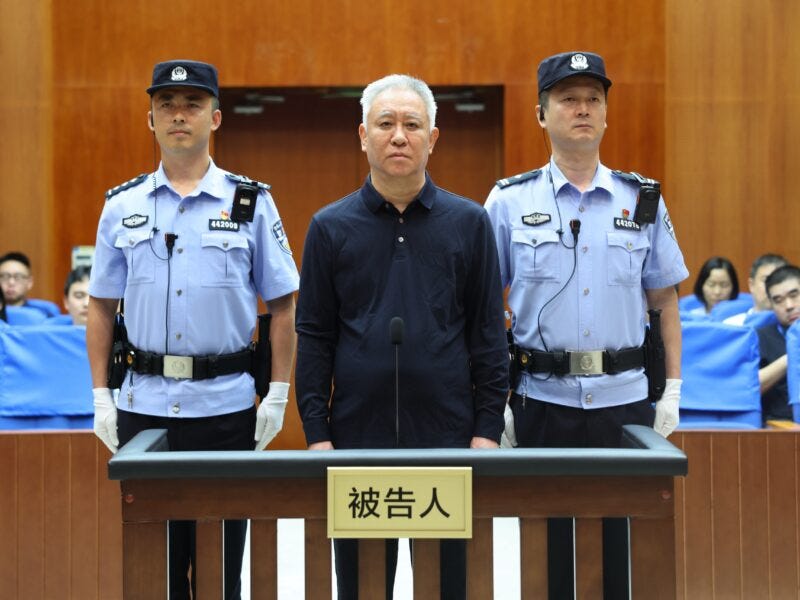
Last week, the former property mogul Xu Jiayin was sentenced to life in prison. Just nine years ago, he’d been China’s richest man, having founded the real estate giant Evergrande. His rise from an impoverished Henan village had been the stuff of legend, but his fall, when it came, also came quickly.
It brings to a close the sorry Evergrande saga since Beijing’s new rules on leverage for property developers, the so-called ‘Three Red Lines’. Introduced in 2020, they stipulated how much debt developers could hold. Evergrande was one of the biggest beasts to fall, the last few years a Sisyphean struggle to refinance itself.
But in my column for The Times this week, I also reflect on how it brings to an end the era of bombastic, debt-fuelled growth that had been unleashed during ‘reform and opening’. This feels particularly true when you consider the death, earlier this month, of former premier Zhu Rongji, who had built the world in which Xu thrived. And yet, as I argue in the column, Xi Jinping’s new economic model, of high-tech manufacturing and exports, is riddled with its own problems. It is not necessarily more egalitarian.
The court found Xu guilty of having inflated the company’s revenues, improperly raised funds from clients and partners, bribed financial institutions, and embezzled company funds via generous dividends. But this isn’t just the story of a particularly crooked mogul. The former businessman turned critic of the CCP, Desmond Shum, put it well on X:
For more than twenty years, Chinese property moved overwhelmingly in one direction: up. There were downturns and tightening cycles, but they were repeatedly followed by powerful recoveries.
Every recovery made the cautious developer look foolish. The aggressive developer who borrowed more, bought more land and expanded faster became richer and bigger.
The lesson was simple:
If you were not fully leveraged, you had missed the opportunity.
After twenty-plus years, excessive leverage stopped feeling excessive. It became normal—almost necessary.
Many developers of that generation were not highly educated. They learned business through experience and became exceptionally good at execution, guanxi, raising money and getting projects done.
…
Putting Xu in prison does not explain why developers across China became so indebted, why supposedly supervised pre-sale funds could disappear, why state-controlled banks kept lending, or why local governments became dependent on ever-rising land prices.
Most importantly, it does not explain why China produced not one Xu Jiayin, but an entire generation of them.
That was not an accident.
The system created the incentives, rewarded the behaviour and profited from the boom.
Developers like Xu were never truly masters of the feast. They were operators inside a much larger machine built and controlled by the state.
The full post is longer, and is worth reading.
In fact, Desmond was already on my mind when thinking about the Xu Jiayin case, even before he’d commented on it. Listeners of Chinese Whispers 1.0 may remember the episode I did with him, having read and enjoyed his memoir, Red Roulette.
One of the deepest impressions that book left on me was the image of extreme wealth in China in the early 2000s. Growing up in that period, I of course remember the massive and rapid boost in living standards. But it wasn’t until I read Desmond’s book before I realised just how rich some of the top nouveau riches were. One of the most grotesque episodes Desmond recounts was about Xu Jiayin. As I summarise in my column:
That heady time is recounted in gory detail in the memoir of businessman-turned-critic of the Chinese Communist Party, Desmond Shum, who now lives in the UK. Shum tells of one trip he and his wife organised to Europe with three other powerful couples.
Their group included the daughter and son-in-law of a member of the Politburo Standing Committee, and Xu and his wife. The eight crazy rich Asians took three private jets (two flew empty, just in case they might be needed), and one evening spent over $100,000 on wine at dinner in Paris.
There’s plenty more details like that in the book, which I’d highly recommend for that insider’s view.
The corruption and economic inequality was becoming a legitimacy issue for the CCP, not least because so often it was high-ranking politicians caught up in scandals (Google the death of Ling Gu). But the growth model that Zhu Rongji had created was also heavily built on debt. As set out by Desmond above, maxxing out your borrowing was the norm, and businessmen approached their opportunities with the risk appetite of gamblers.
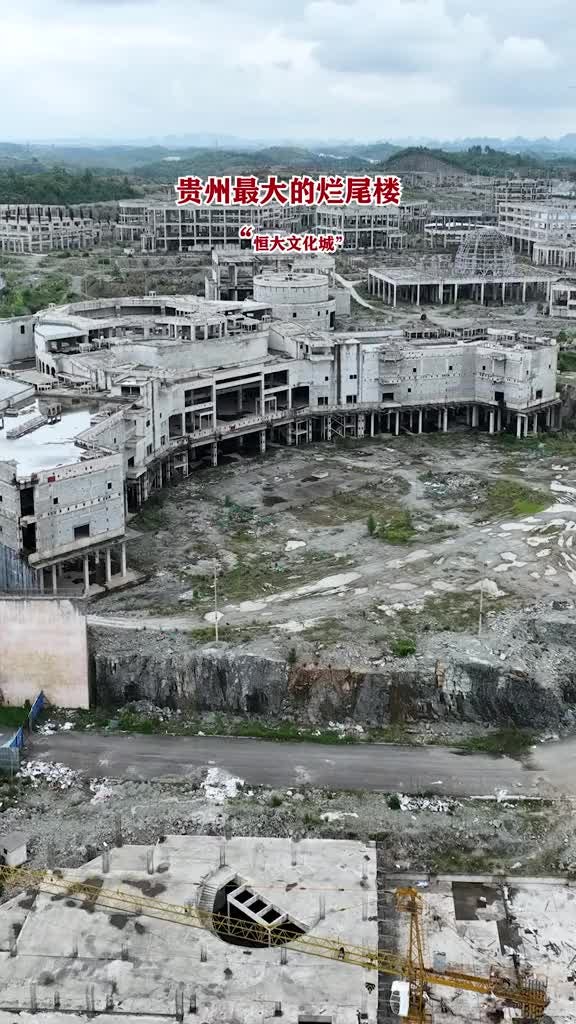
As you may know, China’s property market also worked by selling properties before they’d fully been constructed (most properties sold were newly built and sold on plans, rather than already-built second-hand properties, as in more established economies). This allowed developers to take the revenues from selling a complex and put it into new projects, instead of finishing the projects that had already sold. The Chinese call these unfinished constructions lanwei lou, 烂尾楼, ‘rotten tail building’. In 2022, Evergrande had an estimated 1.2 million unfinished homes, but had nevertheless branched into football clubs, a bottled water brand, and a $1.3 billion mega-resort in Hainan.
Below, an unfinished Evergrande project in Guizhou, which would have been a retail complex spanning 5.3 square kilometres.
 Tiktok failed to load.
Enable 3rd party cookies or use another browser
Fearing a financial crisis akin to 2008, as soon as the debts were called in, Xi and the Party began talking about how ‘houses were for living in, not for speculating’, as early as 2016. But it wasn’t until 2020 when the Three Red Lines were brought in.
Many economists would agree that something had to be done to deflate the housing bubble before it burst on its own, and potentially taking down the entire Chinese economy. But my column also looks at Xi’s promise, then, of ‘common prosperity’ – sharing out the newly created wealth more equitably. In 2015, the top 1 per cent of Chinese owned 30 per cent of national wealth, whereas the bottom 50 per cent owned only 6 per cent.
Today’s economic model is more tech-driven, with Huawei’s Ren Zhengfei and BYD’s Wang Chuanfu more favoured than property moguls like Xu Jiayin. That has been incredible for China becoming an industrial and high-tech powerhouse, and indeed it is the stuff of nightmares for other countries and companies worldwide.
Yet, unlike property, the high-tech industry requires minimal human hands. At its height, the real estate industry accounted for up to a quarter of Chinese GDP, in all the correlating business it spurred in areas like construction, steel and cement, home appliances, and professional services. If you take into account the infrastructure needed to serve new neighbourhoods, then that goes up to a third of GDP. But the economic opportunities in the tech industry are more concentrated – they are white-collar engineers, some blue-collar workers but who are increasingly automated, and, as I mention, this new elite of tycoons.
So in the aftermath of the property market deflation, what we’ve seen is more of a ‘K-shaped’ development for the Chinese economy: where high-tech sectors are booming, but consumer-based, domestic-serving, and other retail sectors are languishing. Not least because the majority of Chinese household wealth had been tied up in housing, which makes the fall in house prices hit their confidence to spend, too.
So is China any more equal today than it was in the world of Zhu and Xu? The World Inequality Database finds that the distribution of wealth is exactly the same in 2024 was it was in 2015: 30 per cent owned by the top 1 per cent, 6 per cent owned by the bottom 50.
The world of Xu was never going to last, but it’s not clear that the economy Xi has built is much better for the little person. If anything, the buccaneering era of Zhu and Xu at least held more hope.
What I’ve been reading:
China poised to lift travel ban on Manus founders – Zijing Wu for the Financial Times. (Gift link). Related to the discussion of a high-tech economy, interesting news from Beijing that executives of the AI company Manus will soon be able to leave China, with their acquisition by Meta set to be unwound.
China Maps Out Oil and Gas Buildout Through 2030 to Strengthen Energy Security – Luo Guoping for Caixin Global. (Gift link). As the headline says. Interesting for the fact that China has thus-far been coal-heavy, and even with its build-up of renewable energy, Beijing is still seeing domestic oil and gas as a part of the energy mix.
A World out of Words – Yangyang Cheng for ChinaFile. On the closure and reopening in Washington of a Shanghai-based bookshop. A long read (really) but worth it.
Picture of the week:
Sam Hogg, formerly of Beijing to Britain, shared these beautiful, retro photos of Hong Kong by photographer Keith MacGregor.


Desmond was as intertwined in the corruption of the era as anyone, and is now marketing himself as some type of explanatory moral compass, while his wife sits in a jail somewhere taking the heat for their shared collaborative activity. The less said of him, the better. The unwinding of the Evergrande (and real estate industry in general) mess will take time, but at least it was stopped and the unwinding is being managed instead of letting it blow up like '08 in America.