

Many Chinese revere Sun Yat-sen, the Guangdong-born revolutionary and political philosopher who, in exile, envisaged a post-imperial China at the turn of the 20th century. He is probably one of the only figures lauded by both the Republic of China (Taiwan) and the People’s Republic (in my home city of Nanjing, a large statue of him stands over the city centre). After revolution broke out in 1911, he returned to China and was the new republic’s first president, and then a leading figure promoting democracy and constitutionalism over the subsequent years.
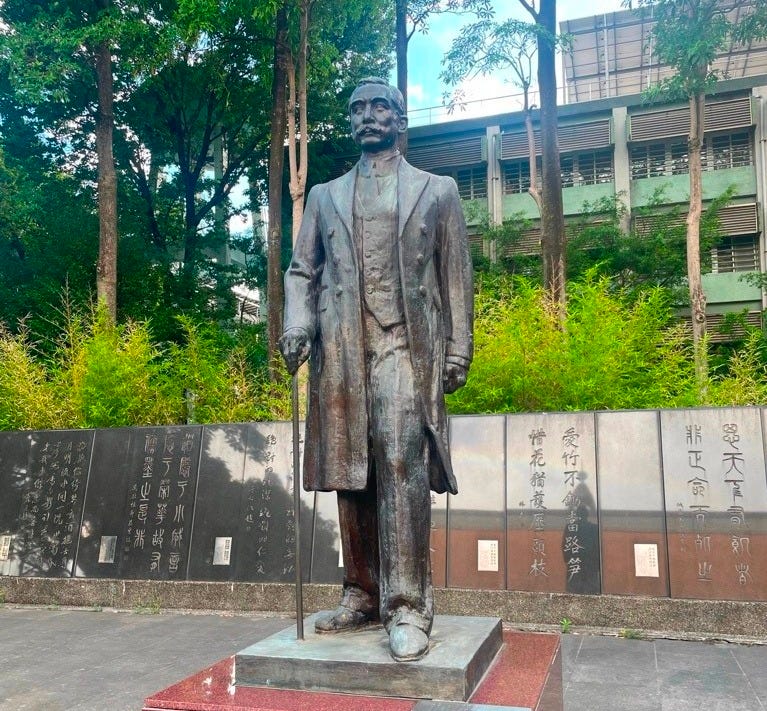
So I feel like the Chinese often turn to him as the role model of when dissidence is done right – thoughtful, principled, constructive opposition. Most importantly, he managed his goal – the establishment of a new China after the fall of the Qing.
In conversation with a Hong Kong exile recently, we lamented the lack of a Sun Yat-sen in today’s overseas dissident movement. Regime change is far from the goal of most realistic dissidents, but even more widely in the movement, there seems to be a paucity of ideas and energy.
I take a look at this phenomenon in my latest column, inspired by last week’s sentencing of Guo Wengui. Guo has been one of America’s most enigmatic figures in the last decade, a Shandong-born billionaire who fled China in 2014 and became a vocal critic of the Party and a darling of Maga. When Steve Bannon was arrested in 2020, he was arrested aboard Guo’s yacht. But his connections go beyond the American right: when he bought his New York penthouse, Guo was aided by a recommendation letter from none other than former British prime minister Tony Blair.
So how did a tycoon like him get sentenced to 30 years by a Manhattan jury? The story itself is well worth your time, with this 2023 long read by Evan Osnos particularly fascinating. In short, he turned out numerous anti-CCP ventures, convincing masses of followers that he is their Sun Yat-sen. In reality, he took their money (over a billion dollars) and spent it on yachts, sports cars and a $26 million New Jersey mansion.
So Sun he is not, and he well deserves his downfall. But in my column, I write that he is merely the most high profile and salacious of a dissident movement that has, since the age of social media, been too willing to peddle falsities about China in the name of bashing Beijing. I write:
A popular genre for dissident creators on YouTube is baseless and racy gossip about Chinese elite politics, which frequently speculates about Xi Jinping’s downfall.
Trump’s rhetoric bashing “Chy-na” won him many dissident fans, but being hitched to the Maga bandwagon has since led some activists to defend his claims that the 2020 election was “stolen” and peddle conspiracies about January 6.
Meanwhile, the pandemic gave rise to all sorts of crazy claims, such as the dissident newspaper Epoch Times reporting that 400 million Chinese had died in the pandemic (which would be more than a quarter of the population).
In each case, truth was just an inconvenient afterthought in the quest to bash the CCP. This is the kind of febrile and truth-light environment that Guo Wengui thrived in, the media network he founded with Bannon’s support also promoting QAnon and anti-vax conspiracies. In 2020, Twitter took down his account with half a million followers.
I also consider the size of the challenge today (the CCP is far more powerful than the Qing dynasty in its later years) and why the Tiananmen Square generation were unable to make something more substantive out of their exile and the world’s sympathy. Do give it a read.
What I’ve been reading/listening to:
The Beginning of the End – Ian Buruma for ChinaFile. A 1995 piece that is still fascinating today, all about the personal disputes between the student leaders of Tiananmen Square, who were far from monolithic or united on the how and the what of what they were trying to achieve.
中国人的流亡和离散 – 不明白播客. Sorry to recommend a Chinese source but this episode of the Bumingbai Podcast is excellent and very on theme. They discuss what it is like to be a Chinese ‘in exile’, what that does to your identity, and what generations of Chinese exiles can teach each other. A truly thoughtful discussion that is well worth your time if you feel your Mandarin might carry through.
How a Free Lunch Helps With a Quiet Crisis in Aging Rural China – Zheng Haipeng for Caixin Global. A lovely long read on a free lunch club that has opened up in a Shandong village for over 80s. The initiative tackles the problems of elderly loneliness, malnutrition and the fact that provisions for the young are no longer as needed, in many villages, than provisions for the old.
And remember, Chinese Whispers is now back as a podcast. I will be releasing at least one new episode each month. For the price of less than a coffee a month ($60 a year), you can listen to the episodes in full by becoming a paid subscriber. I will also release 10 minute previews of each episode so you get a sense of what you’re getting!
The last episode is available for everyone here – it’s all about regional stereotypes that the Chinese have for each other:
Your favourite podcast is back!

One of the hardest things about leaving The Spectator magazine was no longer creating and hosting the podcast, Chinese Whispers. Founded in 2020 as (I’m pretty sure) Britain’s first China podcast, it was also my baby. Over the years we racked up over 200 episodes, covering everything from China’s obsession with Taiwan to the Chinese ketamine craze of th…
I am old enough to recall Soviet dissidents such as Aleksander Solzhenitsyn and Andrei Shakarov, who's travails received considerable attention in Western media. I have often wondered why no comparable anti-CCP figures have arisen. Having considered the tedious (and false) 'China is different', 'the CCP is all-powerful', and 'the West is racist' notions, I have come to a weighty conclusion: the answer is, I think, simply, not yet.
I suspect, or at least hope, it will be somebody like Jung Chang, with a compelling story, an easy manner and the simple unrelenting faith of (say) the Dali Lama. Oh, and a love for China, its people and traditions that transcends anything the CCP have to offer; which, it seems to me, is not so difficult.
Sasha- you have a complex worthy of a politburo member grousing over the century of humiliation. By your standard, who the f—k was Thomas Jefferson? As for Mainland Chinese, I dated someone who attended the school bearing his name. “Look it up on the internet “ she told me.