

Last week I attended a defence and geopolitics conference at the Hague, held on the first day in the Peace Palace and on the second in Leiden University.
It was the first conference of this kind, designed to target the ‘next generation’ of thinkers, analysts, advisors, etc etc, who would work in the defence and geopolitical world. The organisers made sure that at least 50 per cent of the attendees were ‘young people’ (I don’t know how they defined the cut-off – and suspect I don’t want to know either). The speakers included the Netherlands’s 39-year-old prime minister, Rob Jetten, who is three months in the job.
With its history of hosting multilateral organisations and contributing to the development of the rules-based-order in the last century, the Hague felt like an incredibly apt location to be reflecting on the potential death of this order in the world today.
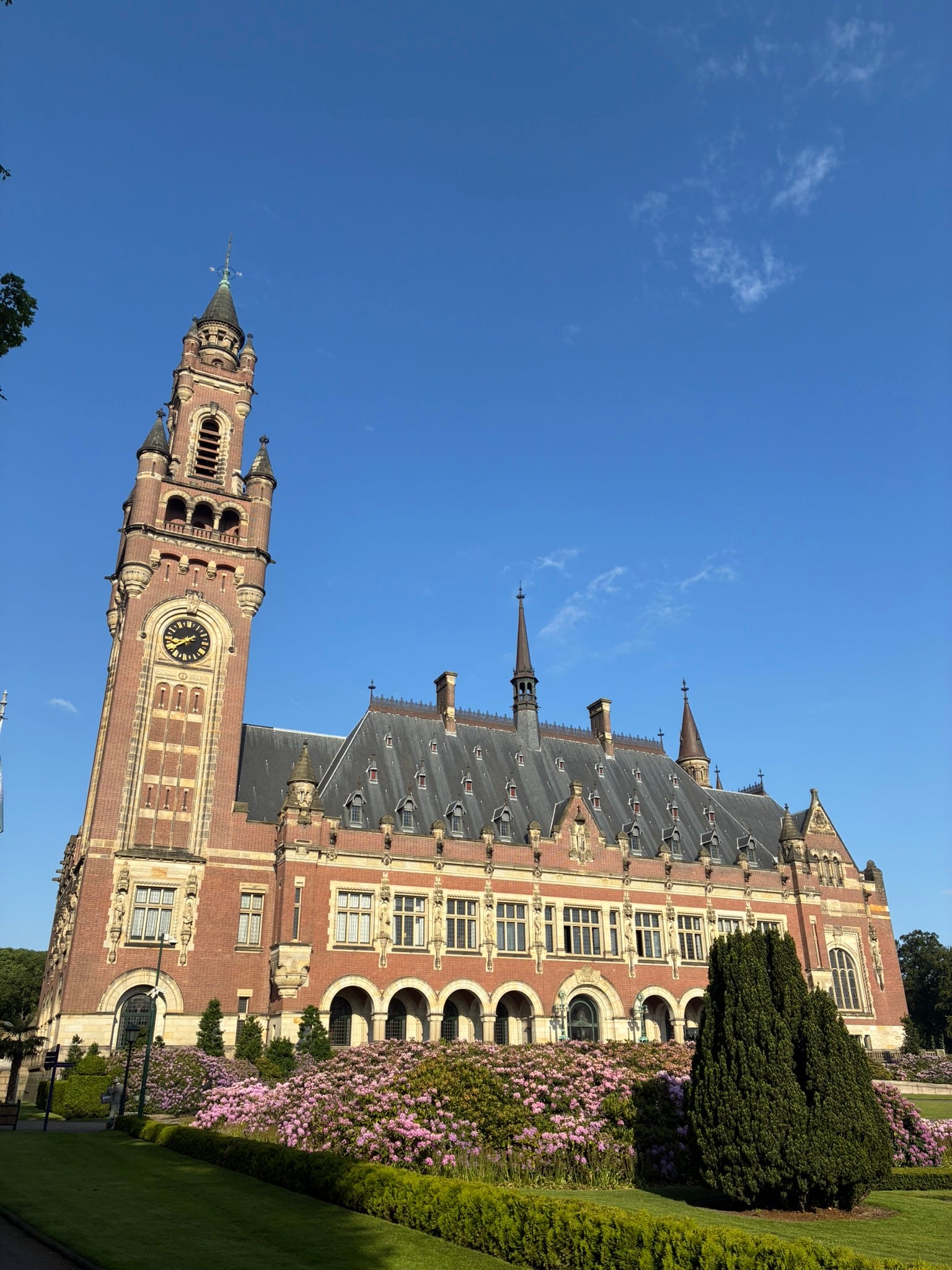
The conference was held under Chatham House rules, so I’m unable to share discussions in detail. But it left me with some general reflections and thoughts.
In panel after panel, China was the shadow that loomed, sometimes unnamed (and curiously, there was no China-specific panel). Its growing economic power underpinned the discussions on Europe’s industrial future and on the longevity, or not, of a multilateral order.
But more than China, I was struck by the discussions on America. On the day before I arrived the Dutch government had just decided to block the takeover of a Dutch IT supplier by an American company – Solvinity provides the app by which Dutch citizens verify their identity to access a range of public services. This comes as the EU more broadly is thinking about ‘tech sovereignty’ and promoting European alternatives to American tech companies. Europe is increasingly talking about America like the UK talks about China.
The Dutch government’s move is popular (indeed one diplomatic grandee I spoke to suggested that its decision was basically forced by a majority of parliamentarians), though it has, of course, met with fury from the United States behind the scenes. The same grandee also told me that the Netherlands would probably not have made this decision if it was not Trump in the White House.
Later, this sentiment was echoed by another retired diplomat (this time American), who suggested that Europe might have allowed the United States to use its air bases to launch attacks on Iran if it had been under a previous presidency.
There was a general sense of disappointment, antagonism, or I might even say anger, at the United States. One Dutch academic questioned why America arm-twisted the Dutch government to block ASML, the Dutch company producing cutting-edge lithographic printers, from exporting its best products to China when the American company Nvidia is able to export far more advanced end-product chips to China.
Aside from tech, on defence, European speakers spoke about America (and its unreliability/hostility) in terms that I might expect them to speak about China instead.
I’m not sure Americans fully appreciate the extent of the European backlash against Washington. It’s certainly not a feeling that London policymakers seem to hold in the same way, probably due to the very understandable factors of a) Brexit and b) a closer transatlantic cultural/political/military tie (I guess whatever people mean by the ‘special relationship’).
There was a fair amount of reflection inspired by Mark Carney’s words at the World Economic Forum, where he called on middle powers to come together. The prevailing sense seemed to be that Europe cannot – and should not – aim for self-sufficiency in the name of security, but one speaker put it nicely as ‘network sovereignty’. I understood that to mean: whatever collection of countries, companies, researchers, or markets you might use, make sure that that ecosystem is a network in which you have sovereignty. (Though I felt suitably chastened when one speaker from a non-European, non-white background pointed out that Carney’s points were hardly original, that non-western ‘middle powers’ have talked about them for years, and yet it took a Carney at Davos for the West to truly pay attention).
So there was a lot of smart thinking, a fair amount of realistic thinking, and certainly an undeniable feel of a world irrevocably changed, that the same old ways to do things won’t work anymore. Yet the problem for Europe, as ever, is down to coordination. I heard how, whether it’s on an integrated capital market that would boost European entrepreneurship or the right kind of foreign investment screening to implement, it takes the EU years to come to a conclusion that all its member states are happy with, if that point is even ever reached.
Some attendees were optimistic that, in an emergency, like the eurozone crisis or the pandemic, Europe can and has come together, and this great power rivalry certainly feels urgent. I find myself not altogether reassured. After all, the challenge posed by China (or a changing America) isn’t one brutal catalyst, but a long, sustained change in international power dynamics. That feels to me to require much more consistent and united thinking than the EU has so far been able to muster.
What I’ve been reading/listening to:
The Middle Power Delusion: Not Choosing Is Not An Option – Michael Beckley in Foreign Affairs. Very relevant to this post, actually, is this thought-provoking retort to the Carney argument, arguing that middle powers have historically survived by bandwagoning with great powers rather than banding against them and staying independent:
The path forward, then, is not endless coalition shopping to route around Washington and Beijing. It is alignment: choosing the great-power system that offers the best shelter from a country’s gravest threat, building national strength, and using that strength to bargain for influence inside the coalition.
Middle power coalitions are indeed very in vogue to discuss, but Beckley raises the real considerations and shortfalls of this approach (not least whether it’s really viable), which I find worth considering. He suggests that the United States is the better superpower to bandwagon with. I suspect that a lot of the people I spoke to last week at the Hague would agree, if it weren’t for the Trump administration’s repeated moves to antagonise Europe.
How the US is Trying to Challenge China’s Critical Mineral Dominance – The China in Africa Podcast. Not the first time I’ve recommended the podcast from Eric Olander. This episode does what it says on the tin, and raises questions about how much you (or specifically the US) can really diversify the critical minerals supply chain.
The ASML point is the one that I keep returning to. The Netherlands gets arm-twisted into blocking its own company from exporting to China while Nvidia faces no equivalent pressure. That asymmetry is hard to explain as anything other than America protecting its own commercial interests while asking allies to absorb the cost. The non-western speaker pointing out that middle power coalitions aren’t a new idea and it just took a Carney at Davos for anyone to pay attention is its own kind of observation about whose voices get heard in these rooms.
I found these articles interesting as potential explanations for why the US is acting the way it is with Europe and NATO...
https://www.compactmag.com/article/why-transatlantic-relations-broke-down/
https://www.compactmag.com/article/there-is-no-post-liberal-international-order/