

No column today as I have been away travelling. Last week I was on the southwestern coast of Turkey, just across from the island of Rhodes. For the most part it was ‘Brits-abroad’ territory – full Englishes served at the local restaurants, Mancunian mums fussing over Hermes and Chanel ‘genuine fakes’ at the markets, a moderate level of surprise by the local Turks when you greet them with ‘Merhaba’ instead of ‘hello’.

But there is a complex and culturally fascinating region beneath the package-holiday veneer. Being British tourists ourselves, we tried to find this as much as we could but no doubt barely scratched the surface. On that one stretch of coast, we saw rock tombs left by the Lycians, a people so old that their language remains largely undeciphered, and the ruins of Roman amphitheatres, built under the glory days of the Byzantine empire.
We stayed at the foot of the abandoned hill-side town of Kayaköy, a stretch of some 500 ruined houses, remnants of the previously bright-blue plasterwork still visible. Its former Greek inhabitants, numbering in the thousands, were displaced and exiled during the First World War as the weakening Ottoman empire gave way to the rise of Turkish nationalism. Suddenly the Greeks were Greeks and the Turks were Turks and they were not permitted to live alongside each other anymore. All in all some 1.2 million Greeks were expelled from the newly-founded Turkey, and 400,000 Muslims from Greece, in a formal population swap in 1923.
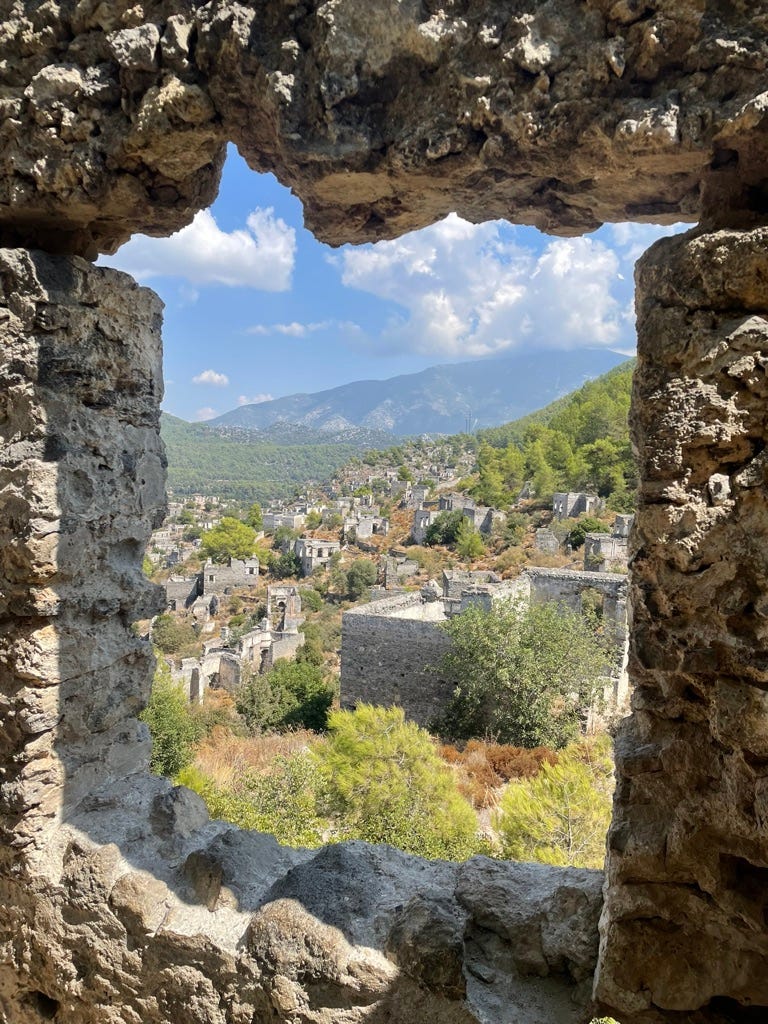
It’s a fiction, but Louis de Bernières’ 2004 novel Birds Without Wings is an evocative imagination of what that must have felt like for a small-town, barely literate population, where the nominally Greek had been there for generations, barely knew what Greece was, and in any case spoke Turkish as their mother-tongue, replaced with Muslims from Crete whose mother-tongue was Greek. In reality, Kayaköy was never repopulated because the new Muslims feared that it was haunted by the Greeks who died there.
Anyway, all this to say that the trip made me reconsider the historical necessity of nationalism. The modern nation-state structure makes national identity feel like a default. We’re ‘British’ or ‘Chinese’ or ‘American’, or whatever else. For some people that stretches beyond the mere biographical details; they feel actively bound to their nation-state, or at least some notion of the civilisation that underpins it, are proud of their identity, will defend their tribe (sometimes violently).
But it is curious to note just how new this default is. Rather than being some primordial fact of human society, it was really the rise of western international law and its application across the world that forced the issue of boundaries, identities, flags. For Turkey that was during the dying of the Ottoman empire; for China, the decline of the Qing. No doubt cultural and linguistic affinities bolstered tribal loyalties before then too, but in the 19th and 20th centuries, nationalism created new dividing lines and tried to formalise these loyalties, as if the inherently messy business of identity is something that can be boxed up, labelled and stacked side by side.
All this reminded me of the episode of Chinese Whispers I did with Chatham House’s Bill Hayton, who wrote The Invention of China. The book details the conscious and deliberate creation of a Chinese identity by revolutionaries and reformers in the late-Qing era, from the creation of a flag to the drawing of national borders and even the choosing of the nation’s name – zhonghua 中华, zhongguo 中国, or something else? All parts of ‘Chineseness’ that modern Chinese might feel are integral to their identities on a primordial level, but that are arguably not even a couple of hundreds’ year old. As in China, so in Turkey.
Other updates:
As I write this news broke that the charges against the two British men accused of spying for China have been dropped. Christopher Cash, then a parliamentary researcher, and Christopher Berry were first arrested in March 2023 and due to face trial next month. The case has shocked Westminster, because Cash had access to senior Conservative MPs. We don’t know any more about why the charges have been dropped at this late juncture, but it’s an unusual development given that (presumably) the threshold for charging under the Official Secrets Act would have been high in the first place.
Less dramatically, on Sunday I will be interviewing the Chinese author Yan Ge about her short story collection, Elsewhere, an anthology of stories about dispossession and diaspora. Register for free here.
Thoughtful - shrewd observations that betray more than a casual conversation over the English breakfast! Turkey took on European nationalism as an antidote to weakness and chose the French unitary state model. The consequences were heavy, but the weakness has transitioned into strength. I'm sure a historian looking at the development of modern Turkey and modern China would find many parallels. In no particular order: an uncomplicated embrace of modernity and technology. An ability to build infrastructure. A love-hate relationship with the West. Obsession with strategic autonomy and energy security. Distrust of regionalism... many differences too, of course.
Cindy, surely you must have been approached by Chinese Intelligence give your influential position and presumably vestigial loyalty to your ancestral home? Would be good material for an article