

Apologies for the long absence in your inboxes – I was in China for most of March. As well as seeing family in Nanjing, I lived in a village on the foothills of the Yellow Mountain 黄山 in Anhui province for a week, and then totally gearshifted to a week in Shenzhen. The culture shock I felt arriving in the city of 18 million, even just after a week of village life, must have been some small echo of the experiences that the hundreds of millions of migrant workers have had over the course of China’s reform and opening. More on that trip, with pictures and thoughts, in the next Stack.
This issue will be about the tricky issue of Ming Yang, 明阳智能, the Guangdong-based company that is China’s largest private turbine manufacturer and the world’s third biggest. Since 2022, the Scottish government has been in conversations with Ming Yang about investing in offshore, helping Scotland achieve its target of 40GW offshore wind by 2040, not least by rolling out a new type of deep-sea turbine – floating rather than fixed-bottom, opening up much more maritime terrain for future wind farms.
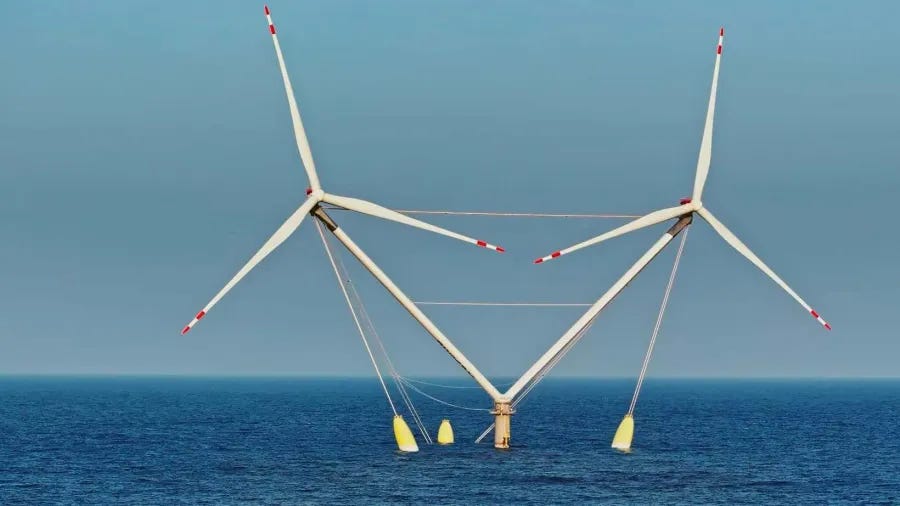
The deal, which has been waiting for approval with the UK government in London for over a year, is for a £1.5 billion investment to revitalise an old oil and gas port in the Highlands into a Ming Yang factory. Ming Yang says that 1,500 jobs will be created. Developers at Green Volt, an offshore wind farm off of Peterhead in Scotland, would like to use Ming Yang’s turbines, which are a third cheaper than European rivals and can scale up in a way that they cannot right now.
Tick tick tick tick. On the face of it there seems little wrong with the deal. But the government in London, last week, said that they couldn’t support it going ahead, citing ‘national security’. They’ve explained little about what exactly the problem could be. Over the last week I’ve spent a lot of time thinking about this issue. Ultimately, I think I agree with the decision to block, as I’ve written in my latest column.
I’m less concerned by the classic cybersecurity arguments against Chinese connected technology: the idea that software could be taken advantage of, giving Beijing a way to remotely control the tech, whether it’s electric cars or turbines. Technical experts disagree about how much of this is an issue, and how much these vulnerabilities couldn’t be mitigated. I don’t know so much about that, but what I do know is that for Beijing to be taking such an action, which would require it to basically instruct a private company to disrupt its clients and destroy its reputation (essentially corporate suicide), is highly unlikely. We’d probably be in a war situation already. Still, I’m sympathetic to the argument that, in an ideal world, we wouldn’t want this option even to be in Beijing’s toolkit.
I’m more persuaded by the economic argument. It’s easy to forget that Europe once had a solar industry. When Chinese rivals came in the 2010s, it didn’t take long for these companies to outcompete European manufacturers and drive the continent’s suppliers to extinction. No hard feelings there – Chinese competitiveness speaks for itself (and I even think subsidies is fair game – why not?). But fair or not, we know now that manufacturing power is an essential part of hard power. Not only because supply chains of other countries come to be reliant on it, but also because it can pivot towards a war footing if, God forbid, we do get there. China gets that better than anyone.
In the wind industry a very similar story is unfolding right now, with Chinese manufacturers accounting for eight of the world’s top ten turbine companies. Denmark’s Vestas and Germany’s Siemens Gamesa are hanging on by a thread. Should the Ming Yang factory have gone ahead, the UK would have become the company’s first overseas factory, a key node in its expansion of its supply chain globally. British wind farms would have been among Ming Yang’s first customers, with Europe possibly to follow. That would have embedded China into British wind energy, and helped the downward slide of Europe’s still fighting wind champions.
I don’t think London should be in the business of doing that.
And on a literal level, the EU is currently drafting new legislation to protect its indigenous producers, including on wind. The new regime will come with subsidies and local content regulations. If post-Brexit UK can still be considered a ‘trusted partner’ of the scheme, then British firms won’t be penalised in the EU’s local content regulations and may well be eligible for these subsidies. In blocking Ming Yang, London is choosing Europe over China, in a middle powers huddle that Mark Carney might be proud of.
I don’t know if this is the reason behind the government’s decision – they’ve stayed remarkably shtum about their thinking, presumably unwilling to court media attention or Chinese backlash (the SNP, though, haven’t stayed quiet). But it’s certainly the argument that I find most persuasive, and just about tips the balance for me to say, let’s choose Vestas over Ming Yang, for now.
In my column I focus more on what this episode has revealed about the UK’s approach to China – still a muddle, with a decision like this taking over a year, and with its blocking coming four years after the SNP first began conversations. It’s a monumental waste of time, and another argument for a clear set of rules of engagement, communicated not just within Whitehall but across civil society (universities, businesses) and devolved governments. It might save us all a lot of time, and help us think more strategically about China.
What do you think?
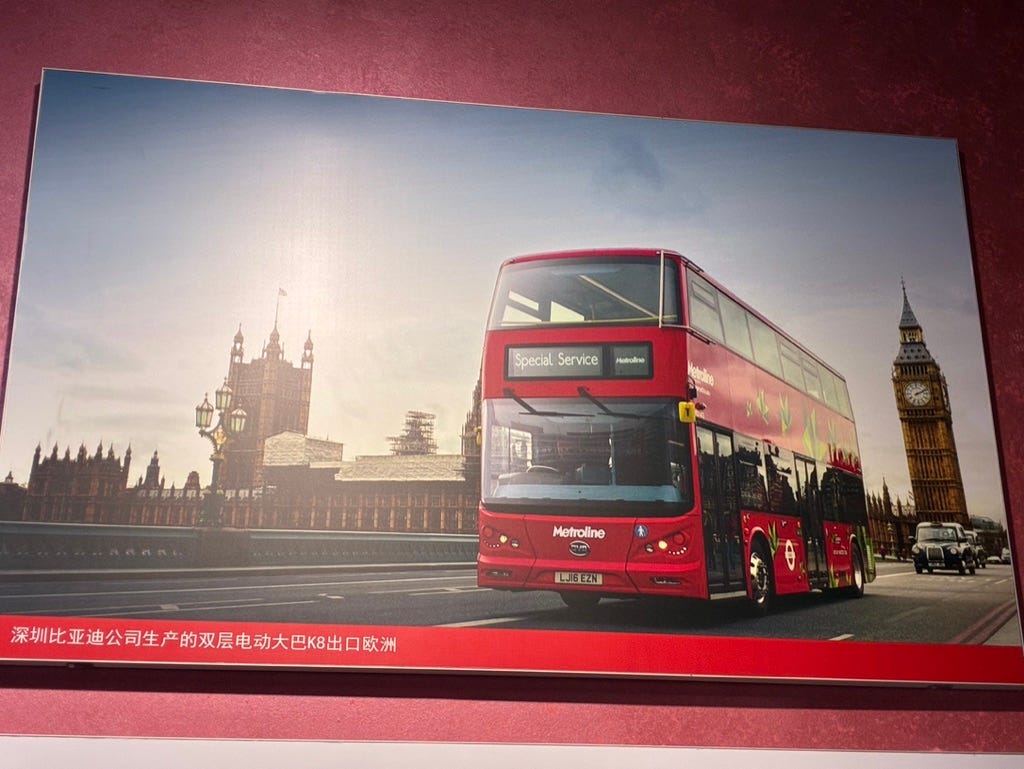
I’ll leave you with a sneak peek of the China trip round-up I will do soon. I took this photo (sorry, wonky) at Shenzhen’s 40 Years of Reform and Opening exhibition, which first opened in 2018. Pictured is a BYD bus, the K8, on the streets of London. The exhibition had gone from a celebration of Deng and Xi Zhongxun to highlight the high-tech, globalised China under Xi Jinping.
Agree with you on the more organised response on these matters. The government would help by being clear on where they stand with China in many respects.
We're going to have get into bed with Chinese companies at some point.