

According to the latest numbers from China’s Ministry of Education, 570,600 Chinese students went abroad last year, down nearly 20 per cent from the 2019 peak and the lowest since 2016. The collapse is mainly in Anglophone destinations – America, Australia, Canada and even a decline in the UK, where there are now more students from India than China.
Half a million Chinese students is still a massive number, but this decline had me wondering about the reasons why.
It’s no accident that 2019 was the high point – the pandemic the next year disrupted university students everywhere, especially those Chinese students enrolled overseas. No doubt the higher inflation in the West and the slower economic growth in China since then has restricted people’s spending habits too, which will include foreign study.
But I think there’s a deeper question here, because once upon a time a British or American education was seen as vital for any middle-class family who could afford it. Whereas now, the conversations I am having with Chinese relatives is about whether a western education is worth it, even when they have the sufficient financial wherewithal.
In my latest Times column I pinpoint the reason as being the decline of the West’s soft power in China:
The China I left in the 2000s put the West on a pedestal. From beauty and architecture to music and food, whatever was western was whatever was popular. Even McDonald’s managed to reinvent itself in China as the place to be for middle-class kids’ birthday parties.
Chinese tour groups became as ubiquitous at European landmarks as gelato stands, while Huawei’s founder, Ren Zhengfei, recreated these landmarks in the company’s Disney-esque main campus (truly a mind-boggling place). British exports held outsized sway: Burberry, Harry Potter, Downton Abbey, Teletubbies and, of course, the royal family.
But that is no longer the case. The rise of guofeng, 国风, which you might roughly translate as ‘Chinese style’, has been happening for a while, from the popularity of hanfu, 汉服, being worn by Gen Z girls on the streets to revived traditional Chinese architecture. In China, domestic brands are no longer seen as lower status than western brands.
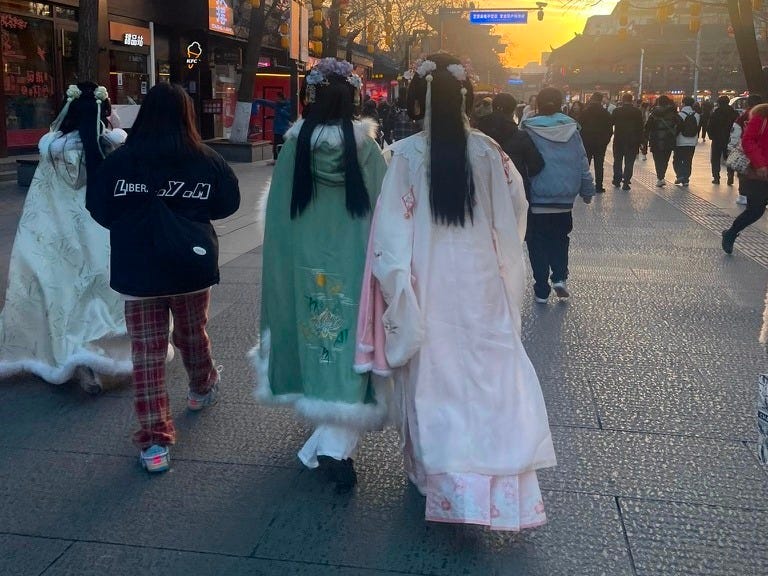
Besides, with more exposure to the West, the fantasy has been punctured by the reality of democratic politics and crime levels, just to give two examples.
The scrutiny on Chinese students in the West in recent years has been one of my bugbears, because I’ve always found it a cruel and reductive way to talk about what are essentially teenagers and twentysomethings with their own desires and ambitions. The handful of cases of spying or theft are hardly representative of the millions of Chinese who have studied abroad since 1978 (almost 10 million, according to Caixin). People will believe all sorts of things about how much Beijing can control these students.
But as much as I’ve disagreed with the discourse, I’ve been impressed by the pragmatism and stoicism of the students I’ve talked to – they are largely unfazed by the hawkish discourse, though it might make them seek solidarity within their own community on foreign campuses even more.
And yet the irony in this latest development is that we may very well have reached peak Chinese students in the West. Those who found their presence a source of angst will breathe a sigh of relief. But is it really a good thing to lose soft power? I can’t help but feel Brits too easily take this rare and much-coveted power for granted, just like how (I imagine) a fish doesn’t know it’s in water. This is the kind of invisible influence that governments like China’s work hard and struggle to recreate; and yet, at the heart of the cultural empire, we are blind to its appeal and instead question the motives of those who do come.
In my research for the column I found some other interesting bits and bobs that I couldn’t fit in, so will share with you here:
Mainland Chinese student numbers in Japan, South Korea, and Hong Kong are rising. Hong Kong is now the second most popular destination.
87 per cent of those who left for studying since 1978 have returned to China. As you may know, they are dubbed haigui, 海归, ‘overseas returnee’, but which is a play on word of 海龟, ‘sea turtle’.
Return numbers were up 29 per cent last year compared to 2023.
But the salary premium they once commanded has collapsed. The average annual salary for a returning graduate fell from 268,200 yuan in 2020 to 204,500 yuan by mid-2023.
While the average study-abroad budget has hit a 12-year high – 605,000 yuan, over £60,000.
What I’ve been reading/listening to:
Why 3 African States Said No to Taiwan – The China in Africa Podcast: I’ve added ‘listening to’ in this section this time, mainly because of this brilliant podcast. The series is fantastic in any case and I highly recommend it to any listener who wants to find out more about, well, China in Africa. But this particular episode was illuminating for its going against the grain of the usual reporting on Lai Ching-te’s botched visit to Eswatini. The received wisdom is that China used economic coercion to force Mauritius, the Seychelles and Madagascar to withdraw approval for Lai’s plane. This episode explains why that is not quite right.
Academics demand apology for scientist investigated for China ties but never charged – Nature: The harrowing story of Jane Ying Wu, a professor of neuroscience at Illinois’s Northwestern University, who committed suicide after being pursued by the China Initiative. This is the second such case I’ve read about this month, after the death of Michigan’s Danhao Wang, a postdoc researcher, who was also questioned by investigators.
Computing Shortage Forces Chinese AI Firms to Ration Services – Caixin Global: A very important and interesting, but underreported story in Caixin. The paper reports that ‘A severe shortage of computing power is forcing major Chinese artificial intelligence model developers and cloud service providers to throttle services, ration access and hike prices as demand outstrips chip supply.’ All of this, of course, is right at the crux of the question over the AI race between China and the US right now: does denying China compute, via export bans on semiconductors, help or hinder China? This suggests limiting compute is a worthwhile pursuit. (Incidentally, let me recommend another podcast: Dwarkesh Patel’s April interview with Nvidia’s Jensen Huang. There’s a lot of heavy tech chat at the beginning, but the debate over Nvidia’s exports to China is genuinely interesting (and a little uncomfortable to listen to at times!))
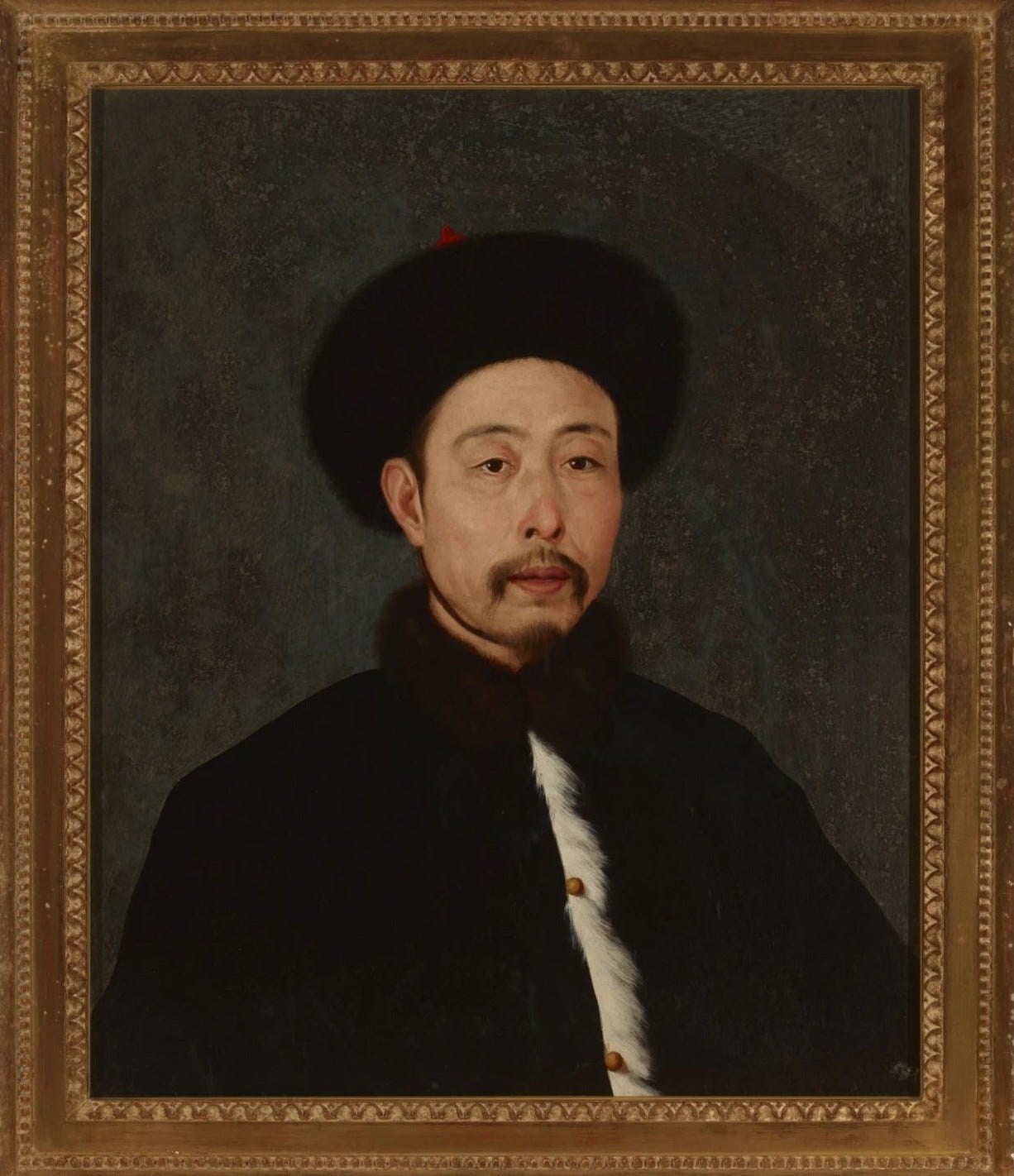
Image of the Stack is this oil painting of Emperor Qianlong by none other than Giuseppe Castiglione, an Italian Jesuit missionary of legendary fame in China (and better known there as Lang Shining 郎世宁). I saw this on X.
The economics is key reason since the Chinese are very pragmatic people. However is not the decline of the West, rather the rise of the East that's luring promising Chinese students. Many Asian universities & schools are rising in global rankings like in Japan, Hong Kong, Macau, Singapore and especially mainland Chinese schools.
So there is diminishing returns especially going too far that's much more expensive. In addition there are lots of "scary trends for Chinese parents", which is the Woke & gender agenda and political participation & inclination of US & UK universities.
The haigui salary premium collapsing from 268k to 204k yuan while the study-abroad budget hits a 12-year high is such a striking combination — people spending more to get a credential that’s worth less. And the irony of the piece is right: the countries most suspicious of Chinese students may be watching them leave and calling it a win while quietly losing something they never thought to protect.