

In last week’s episode of Chinese Whispers, my guest Ed Lawrence told me that zero Covid had a real impact on his mental health, as a journalist who lived in Shanghai through the 2023 lockdown and that year’s ramp-up of measures to tackle Omicron. These included arbitrary quarantining, daily swab tests, and ostracisation by people from other parts of China. It was purgatory.
Arrested in Shanghai
·When covering the White Paper protests of November 2022, BBC senior journalist Ed Lawrence was beaten and detained by Chinese police in Shanghai. Footage of his arrest travelled quickly, and resulted in a near diplomatic incident, with the British Foreign Office summoning the Chinese ambassador in London. Fortunately, Ed was released after some five hou…

In my column for The Times today, I write on a similar theme of Covid’s impact on mental health and other facets of life – but for British teens. In the UK, there are currently more than a million 16-24 year olds who are not in employment, education or training (NEETs). There’s an image of this generation as being fragile, unprepared for adulthood, and perhaps even lazy. The blame has been variously laid at smartphones, therapy culture, the welfare state.
But I point out that this is also the generation who had at least two years of their adolescence disrupted by Covid. Schools were cancelled and socialisation moved to almost entirely online. The usual ways in which schools in England had prepared its students for the future – in particular the work experience that most schools encouraged in the 90s and 2000s – were cancelled in the height of lockdown. The usual ways in which teens grow up, find themselves and learn how to socialise were also disrupted. Is it any wonder that the kids aren’t quite alright?
If you are interested, you can read the column by clicking the button above. But for readers of this Substack, I thought it would be a good chance to compare the life chances and experiences of this same generation in China. Do they fare any better?
First, a reminder of the context. China’s lockdowns were both more severe and less consistent than the UK’s, making it harder to generalise about experiences. In other words, whereas some cities locked down hard and for long periods of time, other cities and towns were generally able to avoid that experience and enjoyed vast lengths of relative freedom. The exception is perhaps 2022, when the Omicron variant really pushed the zero Covid regime to the brink in much of the country. That is the year that most Chinese recollect as being the hardest of the pandemic.
So, no wonder that protests broke out in November 2022 across multiple cities (again something that Ed and I talked about). Notwithstanding the variation in Covid experiences, there was a prevalent narrative among young people: ‘青春才几年,疫情占三年’, or roughly translated ‘youth is short enough as it is, Covid stole three years’. As in the UK and other countries, young people knew that they were making sacrifices to protect other generations. East China Normal University’s Professor Xu Jilin talks more about this discourse in his (Chinese-language) podcast.
And now, the jobs landscape is every bit as harsh as it is in the UK, and probably more so. Youth unemployment in June was 14.9 per cent. It’s a 12 month low, but still three times the overall urban unemployment rate. In the UK, the unemployment rate for the same age group is 16 per cent, but that statistic counts students who are looking for work, which the Chinese measure no longer includes. Meanwhile, the supply of graduates rises year by year. This year, an estimated 12.7 million new graduates enter the job market, two million more than in 2022.
This leads to a familiar set of vocabulary, at its core the twin phenomena of tangping, lying flat, and neijuan, involution. You know all about that already. I guess one difference with the UK here is that I don’t see much involution. As grim as the jobs market is, British kids are simply more likely to doss around (and here is where the welfare state does play a part), whereas Chinese kids, not least egged on by anxious parents from a more cutthroat age, mostly can’t rest.
A 2024 graduate survey from Zhaopin, a Chinese recruitment agency, found that more than three quarters of graduates had done at least one internship; and almost a third had two or more. I haven’t found a source that asks the same question of university-age students in the UK, but for my column I found that the proportion of secondary schools in which a majority of students had done work experience dropped by a third between 2019 and 2021, to only two in five schools systematically encouraging work experience.
To set themselves apart and delay employment, more and more young Chinese are staying in education. In the decade to 2024, the annual enrolment in postgraduate studies more than doubled from 645,000 to 1.36 million. With five million graduating from an academic bachelor’s degree each year (as opposed to a vocational degree), that’s about one in four academic graduates continuing their university education.
But it could be delaying the inevitable, and increasingly, there’s a sense that reality is not matching the expectations of what education can win you. This gives way to the meme of Kong Yiji, the protagonist of a short story of the same name by Lu Xun. Kong is a traditional Confucian scholar who refuses to adapt to a new, post-Confucian China. His tattered scholar’s robe is a emblem of his over-education and unsuitability for a new era. As I wrote in Foreign Policy previously:
You don’t need a master’s degree to roll tobacco, so when China Tobacco Henan announced that almost a third of its new factory-floor hires had postgraduate degrees, it triggered a national debate in China. Weren’t these highly educated young people wasted on the assembly line? Or did they in fact make the sensible decision, given the job security and competitive pay—roughly 8,300 yuan (around $1,200) a month, compared with a graduate average of 5,800 yuan ($835) a month—at the state-owned tobacco factory?
…
Online, the unemployed compare themselves to Kong Yiji, the eponymous protagonist of a 1919 short story by Lu Xun, China’s most lauded novelist of the last century. In the story, Kong is a relic, and his half-baked classical education (symbolized by his ratty scholar’s gown) hindered rather than helped him adapt to the changing times. He is a laughing stock to the uneducated townspeople and an object of contempt to the well-connected and successful officials from whom he tries to steal books.
A century later, the joke is now on China’s Generation Z, who self-deprecatingly meme themselves as modern-day Kong Yijis, lamenting that their education has hobbled their ability to adapt to a China with fewer prospects. They dub the trend “Kong Yiji literature” and have spun it off into a song and a cartoon strip.
In this uncertain landscape, more and more young people are looking for iron rice bowls: specifically in the civil service. They call it shang’an, 上岸 ‘reaching the shore’, in contrast to the trend in the height of reform and opening of xiahai, 下海 ‘going down to sea’. If xiahai was leaving the warm but rigid embrace of the state sector to make your own way in a booming private sector, the children of those who dived into the sea are now looking for precisely that groundedness on land. To maximise their chances, some graduates do xunkao, 巡考, which is registering for civil service exams in multiple regions to maximise their chances of success.
If all that sounds stressful, then you will not be surprised to see the mental health statistics for this generation. According to the Institute of Psychology at the Chinese Academy of Sciences, almost one in four 18 to 24 year olds are at risk of depression, which is more than double the rate for adults in general.
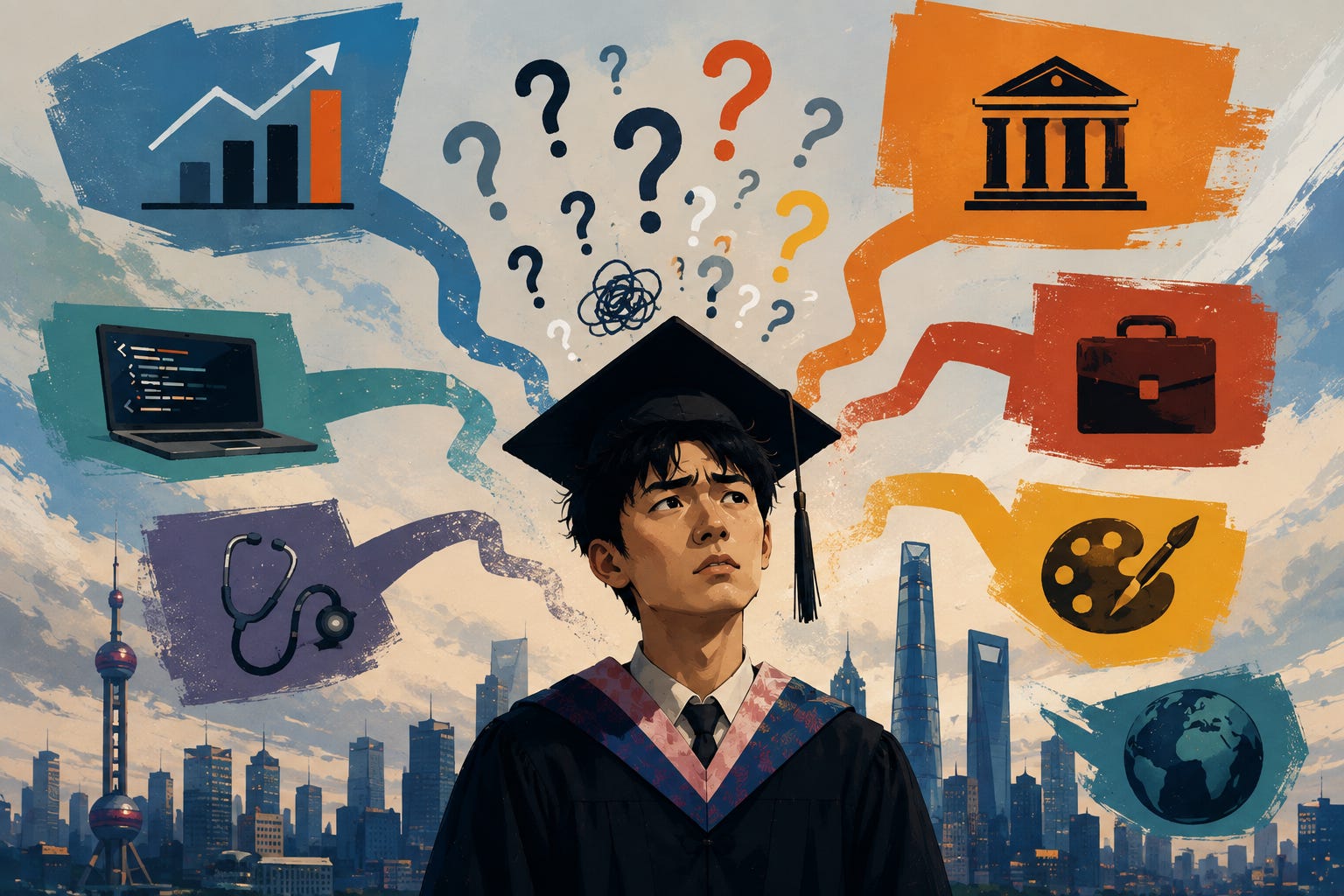
So the kids, in China, are not alright either, and young adulthood is almost certainly more stressful in China than it is in the UK. The factors go beyond just a few years’ of lockdown: China’s cultural emphasis on education, the intensity of competition, the thin welfare state all contribute to an even harsher landscape for the young.
But there are reasons for hope. Some of this discourse gains salience partly because young people are better at talking about their feelings and setting their boundaries. By sheer measures of harshness, there is no comparison to their parents, who lived through a newly opening economy, or their grandparents who lived through the civil war, the Great Leap Forward and the Cultural Revolution.
And yet this generation are unwilling to be the chattel, or workhorses, that their elders were (they literally use the term 牛马, ‘oxes and horses’, to describe how much workers could be exploited). Instead, young Chinese today are said to be ‘fixing the workplace’, ‘00后整顿职场’. When a boss asks for a meeting at 6pm, they might ask if there’s overtime pay, or when HR asks for an emergency contact, they might simply refuse in order to protect their private lives. The sentiment of boundary setting is familiar to us in the West. Older generations can think this is entitlement or laziness, but younger generations simply say: it is their due.
What I’ve been reading:
The following guest post from Zichen Wang’s excellent Substack, Pekingnology, on the state of women’s rights in China today.

China’s Elderly Population Tops 323 Million as Aging Pressures Mount – Xu Wen for Caixin. Latest figures show that almost one in four Chinese are now over the age of 60.
Expats Flock Back to Hong Kong Seeking Low Taxes, Better Jobs – Denise Wee et al for Bloomberg. Interesting long read on the expats going back to Hong Kong now.
Just another perspective. Asian parents and their children in NSW Australia still highly value education. State Selectives are the most successful schools in the Year 12 exams. They do not admit overseas students, so the students and their parents are Australian citizens. Asian heritage parents, unlike European heritage, pay large amounts for selective entry test coaching colleges - the schools themselves are not fee paying.
Major NSW state (not private) selective schools
James Ruse Agricultural High 97% Extremely high Asian-background population; Chinese and other East Asian, Indian/South Asian and Southeast Asian backgrounds are prominent. Topped State for 22 years. Over 90% of parents speak a language other than English at home.
Baulkham Hills High ~95% Very large Asian-background population, particularly Chinese/East Asian and South Asian
North Sydney Boys High 93–94% Very large Asian-background population; substantial Chinese/East Asian and South Asian representation
North Sydney Girls High ~93% Very large Asian-background population; Chinese/East Asian and South Asian backgrounds prominent
Sydney Girls High 89% Very high Asian-background population, with Chinese/East Asian and South Asian communities particularly prominent
Hurlstone Agricultural High ~80% (older data) Particularly notable Vietnamese background; Vietnamese students were 24% in 2017