

The Westminster spy trial collapsed because of cock-up rather than conspiracy. That’s the verdict of the cross-party Joint Committee on the National Security Strategy, which took evidence from ministers, prosecutors, senior Whitehall officials, and consulted experts including Jonathan Sumption, former Justice of the Supreme Court.
“We did not find evidence of a co-ordinated high level effort to bring about the collapse of the prosecution,” the report concludes. But the process was “beset by confusion and misaligned expectations” – in a word, “shambolic”.
So what actually went wrong? Three questions dominated the post-mortem: Did the case collapse because the government refused to call China an “enemy”? Was there political interference? And if neither, then what?
The case did not collapse because the government refused to brand China an “enemy”
This was the theory that gained the most traction: that the prosecution failed because ministers wouldn’t formally designate China a hostile state.
The reality is more technical – and arguably more frustrating. The Director of Public Prosecutions explained that the Deputy National Security Adviser’s evidence “did not need to use the word ‘enemy’. By basing a case on threat to national security, we would meet the legal requirement, so it is not a question of using a word.”

The trouble came after a ruling on a separate Bulgarian spy ring case, which the CPS interpreted as requiring the Cash/Berry prosecution to now demonstrate that China was a “current threat” at the material time.

But the Joint Committee questions this interpretation. “This conclusion was not immediately obvious to us”. Lord Sumption agrees, finding it “surprising that the witness statements of Mr Collins, the DNSA, were not regarded as sufficient to establish that China was a threat to national security.”
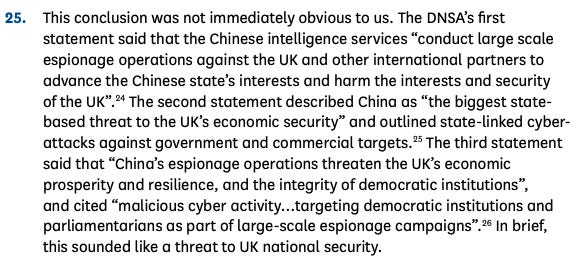
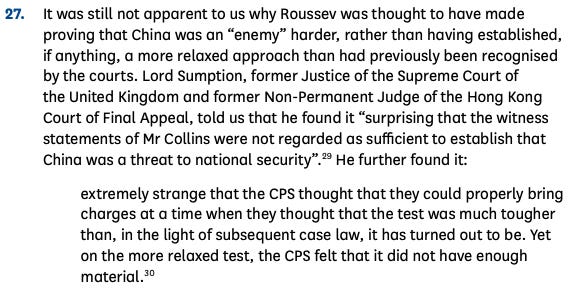
What Matthew Collins, the DNSA, actually said was that “China’s espionage operations threaten the UK’s economic prosperity and resilience, and the integrity of our democratic institutions.” The CPS deemed this insufficient to prove China was an “active” or “current” threat.
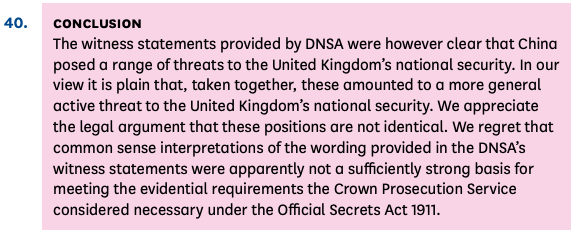
The Joint Committee’s verdict is pointed: “We regret that common sense interpretations of the wording provided in the DNSA’s witness statements were apparently not a sufficiently strong basis for meeting the evidential requirements the Crown Prosecution Service considered necessary under the Official Secrets Act 1911.”
The case did not collapse because of political pressure
The most explosive accusations centred on Jonathan Powell, the National Security Advisor, and Richard Hermer, the Attorney General. Did they improperly influence the trial or deliberately collapse it?
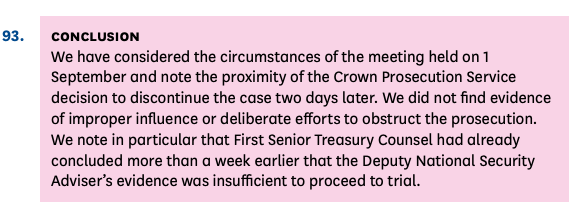
The Joint Committee’s answer: no. “We did not find evidence of improper influence or deliberate efforts to obstruct the prosecution.”
On Powell’s 1 September meeting with senior officials – coming just two days before the CPS informed Hermer the case would be discontinued – the Committee heard that the meeting concerned how to “manage diplomatic relations” if the trial went ahead, with “at least four lawyers in the room” to ensure “the discussion stayed where it was supposed to be.” Crucially, Tom Little KC, the CPS’s lead prosecutor, had already concluded more than a week earlier that the DNSA’s evidence was insufficient to proceed.
On the DNSA’s third witness statement containing wording remarkably similar to the Labour manifesto – Collins told the Committee he had been asked by Counter Terrorism Police to “include a reference to the new Government’s policy for fear that a wedge would be driven between my witness statements and the new Government’s policy.” He drew on wording from a parliamentary question rather than the manifesto itself. However, the Committee does note that it remains “unclear” why this language appeared only in the third statement, not the second.
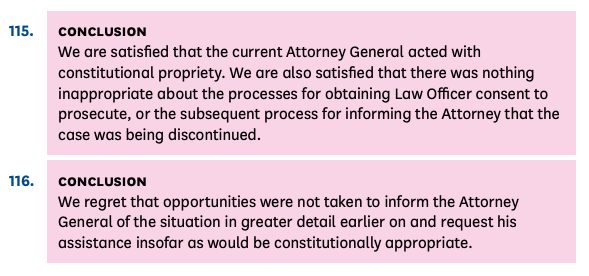
On the role of Hermer, who was informed on 3 September that the case would be dropped, the Committee consulted Sumption, Jonathan Hall KC, and former Attorney General Dominic Grieve on what an Attorney General’s role was to prevent the case from collapsing. All agreed that overruling the CPS’s decision would have been “unjustifiable interference” (in the words of Grieve). The Committee concludes that “the current Attorney General acted with constitutional propriety.”
The process was shambolic – and the problems are systemic
If neither the “enemy” question nor political interference explains the collapse, what does? As well as the outdated Official Secrets Act, the Joint Committee identifies deep procedural failures.
The delays alone are damning: eight months for the DNSA to provide a second witness statement to the CPS, and six months for the third. There was a fundamental “mismatch” – the CPS wanted statements of fact, while Collins, as a civil servant, insisted he could only stick to stated government policy. Senior civil servants, including the Cabinet Secretary, gave the case insufficient attention and support. And because Powell is a political appointee rather than a civil servant, his deputy was left isolated and exposed.
The Committee’s recommendations aim to prevent a repeat. It calls for greater clarity on “the capacity in which the DNSA was giving evidence, and the extent to which civil servants can act as witnesses of fact on matters that are not made explicit by government policy.” It wants more institutional support for officials in Collins’s position, whose “position as a government witness was quite isolated.” It urges faster communication between the CPS and government to “identify potential evidential issues from the outset.” And it calls for a government exercise to stress-test the National Security Act and determine whether it can overcome these procedural failures.
My reflections
The above is the same as I have posted on X in a long, technical thread. I wanted to aim for impartiality, to solely inform concerned readers of this latest chapter in the saga.
But if you ask for my own opinion, there are two takeaways I have from this report.
One: the spy trial may have collapsed through incompetence rather than conspiracy. But the lesson is hardly reassuring: Britain’s national security apparatus couldn’t coordinate itself well enough to prosecute alleged spies for China. Now, we are in a situation where either two guilty men have escaped punishment, or two innocent men have had their names forever smeared.
Two: the report comes as a welcome corrective for the hysteria and paranoia that dominated the UK-China conversation in the last few months. It is of course possible, and has always been plausible, that this was a cock-up rather than conspiracy. And yet, the level of conspiratorial speculation that was whipped up in the conversation, by the opposition party and by the media, is a clear sign to me of how deeply toxic and unhealthy the UK’s discussion on China is.
For the same reason, we can be sure that this report won’t receive nearly as much attention as the smears and conspiracies did.
I'm sure you're right that this report won’t receive nearly as much attention as the smears and conspiracies did.
All the more reason to be grateful that you have highlighted it.
Thanks Cindy for highlighting and analysing the detail of this important report. It is regrettable that it is getting far less attention than the original decision.