

Donald Trump might be Beijing’s most unlikely comrade, pushing allies away from America and straight into its charm offensive. No wonder that China’s favourite nickname for Trump is ‘Chuan Jianguo’, Chuan a transliteration of ‘Trump’ and Jianguo meaning: ‘to build the nation’. In other words, that the American President is making China great again.
In a weekend essay for The Times, I write about how, as Trump withdraws aid, imposes tariffs, and abandons global commitments, Xi Jinping is busy rolling out the red carpet for countries left adrift and bruised western leaders (including Australia’s Albanese, who had a private lunch with Xi last month).

The impact can be seen in the numbers: the latest Pew polling shows that there has been a collapse in American popularity globally, while in many countries, China’s favourability is improving for the first time since the pandemic. Quite a coup for Comrade Jianguo.
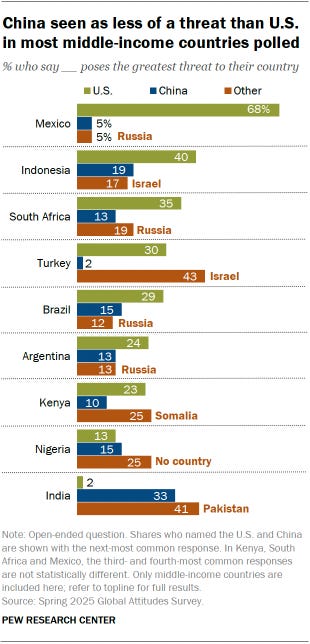
Other world and national polling suggests a similar dynamic. Of course, world leaders are not just sheep flocking to one herd if kicked out by the other (not generally, anyway), and most interestingly is a trend towards grouping together, away from both America and China, for middle powers. But Trump 2.0 certainly creates a rare opportunity for Xi.
But while things might be working out on the global stage, at home, the demographic problem shows no signs of easing. China now accounts for over a quarter of the world’s elderly, but only seven per cent of its newborns.
Yet you might be surprised at the slowness with which the national government is dealing with this problem. Other than loosening the one-child policy since 2015, there really has been very little by way of national pronatal policies.
That changed last week – when the central government introduced its first national subsidy: 3,600 RMB per year per child under the age of three (£375 or $500). It’s certainly a milestone and has been welcomed by concerned demographers.
But in reality it is a drop in the ocean for parents and would-be parents – Yuwa Population Research, a Chinese demographic think-tank, estimates that it costs the average rural family 365,000 yuan to raise a child to adulthood (£38,000, or $51,000), and 667,000 yuan in cities and towns (£70,000, or $93,000). I asked a friend in Nanjing, a mother-of-two who is now eligible for the money, her thoughts. She pointed out that the 300 RMB a month equates to ‘two trips to a soft play centre or two swimming lessons’ in the tier-2 city. Certainly not enough to persuade her to have a third.
Caixin featured an interesting proposal from Liang Jianzhang, a tech tycoon by day (founder of travel company Ctrip) and pronatalist campaigner by night. He suggests that China should pay parents 1,000 yuan a month for their first child, an additional 2,000 yuan for their second and 3,000 for their third, so a family of five would have 6,000 yuan each month, until adulthood. Add rebates on income tax, social security and mortgage interest and Liang’s manifesto would cost 2 to 5 per cent of Chinese GDP.
And yet, is cash even the answer? I pose this question in my latest Times column. It seems to me that pronatalists who advocate for cash injections miss a crucial factor of low fertility – the education and expanded aspirations of women. Until more gender equality can be achieved at home and in the workplace, such that mothers are not penalised more than fathers, no amount of money will convince some modern women to have babies earlier/more babies/babies at all.
Other updates:
If any Substackers came to my event with Yuan Yang in Covent Garden a couple of weeks ago, thanks! If not, you can now watch the whole thing on YouTube. We actually ended up talking as much about British politics and immigrant participation, than China itself.
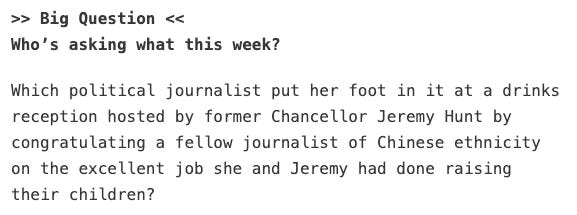
A tip for any professional schmoozers and networkers: don’t assume the identity of the stranger you are talking to unless confirmed, especially if you might be mistaking minorities… The following incident was reported by Popbitch, a political and celebrity gossip newsletter (highly recommend). Three separate friends asked me if I was the unfortunate Chinese journalist in question – sadly not, because it would have been a hell of a good anecdote…
Some time ago, issue was human overpopulation & now to aging population. I have faith that humans (& Chinese) would figure out how to live well with declining population. That said, in less than 60 years, China almost triple its population even with 1-Child policy. And with high household savings rate like Korea, Japan, Singapore also facing aging population, I do not see similar economic challenges as Europe where current working adults are funding retirees that now live much longer.
In decades to come, China could become like Korea & Japan today, where more people would live in major cities. Countryside, small towns & villages getting less people & returning to nature. Yes, economy may not be as fast & they tapping on their huge retirement savings, but would consume much less.
BTW, to convince women, who are real decision makers for babies, is more than money. Its the forgoing of career, lifestyles, beauty (youth) vs having children with overbearing need to make them superkids. This is huge debate in many East Asian nations... and we still don't have good conclusions.
I think the One Child Policy taught China’s people and China’s leaders a bit of humility regarding managing demographics.
Like you, I won’t mention China’s booming robotics industry.