

25 years ago this Friday, hijacked planes flew into the Twin Towers and the Pentagon. The shock and pain of that day metastasised into two decades of war, costing trillions of dollars and thousands of American lives (and hundreds of thousands globally).
At the 16th Party Congress, in 2002, the Chinese leadership identified that it had ‘a period of strategic opportunity’ 战略机遇期. Though the official language didn’t explicitly link this window of opportunity to the war on terror, it was spelled out elsewhere. ‘The longer the United States makes counterterrorism the central task of its strategy, the longer China’s period of international strategic opportunity will last’, Wang Jisi, an influential foreign-policy scholar at both Peking University and the Communist Party’s Central Party School, had written in 2008.
In my latest column, I look at the way the fates of America and China diverged after 9/11. China joined the WTO exactly three months later, and focused on getting rich and embedding itself into the world economy. Meanwhile, America was mired down in seemingly endless wars. Between 9/11 and the withdrawal of US forces from Afghanistan under Joe Biden, China’s economy grew by 13 times in nominal terms, overtaking France, Britain, Germany, and Japan.
We will never know whether Washington would have scrutinised and challenged China’s rise earlier, had the Middle East not taken up so much bandwidth.
In the column I mainly focus on the lessons for Chinese foreign policy from the war on terror: don’t over-extend in expensive foreign wars, make friends but commit to no one, and avoid ideological blindspots. As Wang wrote:
在世界其他大国都没有确定主要敌手的新世纪,美国却把战略目标指向一个无法消灭(甚至无法明确界定)的敌人。
In a new century when no other major world power had identified a principal enemy, America somehow directed its strategic focus towards an enemy that could not be eliminated – or even clearly defined.
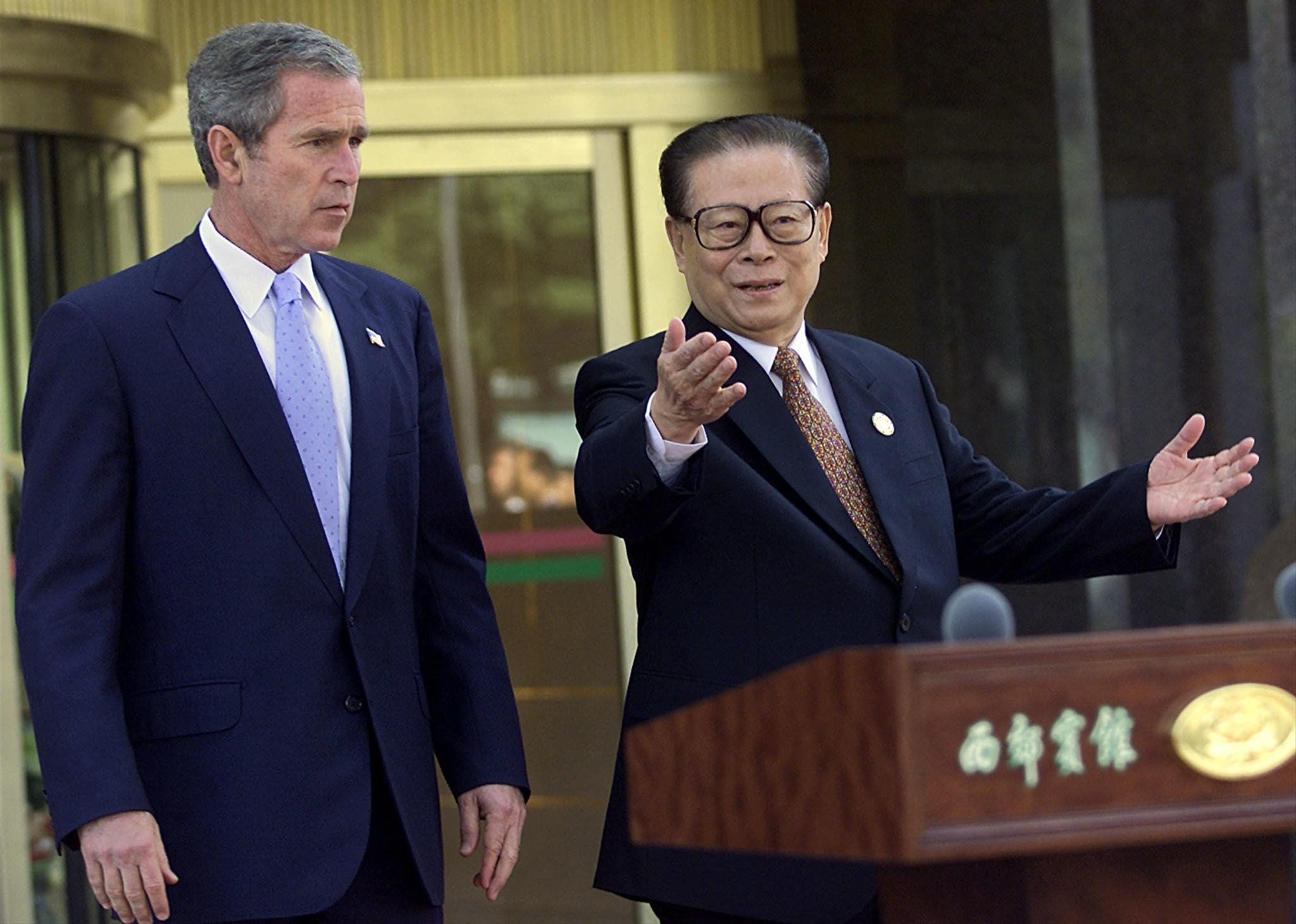
One thing that I didn’t have much space for in the column, but which I would have liked to include, is China’s response to 9/11 and its aftermath. Jiang Zemin was actually one of the first to call George W. Bush to offer his condolences. And in the months following the war, US-China relations improved (despite America’s support for China joining the WTO, Bush had sounded decidedly more critical of China than Bill Clinton on the 2001 campaign trail).
China had its own interests in promoting a counter-terror narrative, of course. Throughout the 1990s tensions had risen in Xinjiang. Growing dissent against Chinese rule had manifested into both peaceful and violent protests against Chinese authorities, including bombings and assassinations. Beijing cracked down hard (literally) in the ‘Strike Hard’ campaign of 1996.
But 9/11 gave Beijing the language of counter-terrorism, and it accused Uighur separatists of being Islamic extremists. No doubt some of them really were – Uighur fighters had been among those captured by US forces. But the war on terror also made it easier for China to bundle wider Uighur dissent into the label of ‘Islamic extremism’.
In 2002, Washington designated the East Turkistan Islamic Movement under a terrorism executive order, and joined China in seeking its inclusion on the UN sanctions list. And decades later, when the US would spotlight China’s mass detention of Uighurs, Beijing would use America’s own transgressions during the war on terror against them. For example, ‘The US itself is an old hand at arbitrary detention’, the Foreign Ministry said in 2022.
On the ground, though, the Chinese reaction was more mixed. There was much more schadenfreude at the attacks from nationalist corners of Chinese society. It was only earlier that year when a Chinese pilot had died after colliding with a US spy plane over Hainan province, and only two years previously when Nato forces had bombed the Chinese embassy in Belgrade (supposedly accidentally). A common refrain at the time: ‘the US is the world's biggest terrorist’.
Today, China has replaced Islamic extremism as America’s principal rival (notwithstanding Donald Trump’s latest misadventures in the Middle East…). That’s not just because the war on terror has run its course (again, notwithstanding Iran…) but also because China has changed. Instead of a measly eighth of the US economy, it is now almost two thirds (again using nominal figures here). It dominates a number of critical technologies – even if not their frontier research, then more likely their industrial supply chains (as I wrote recently in the context of AI).
There's more than one way to win the AI arms race

In last week’s post I wrote about the good week that China has had, off the back of a statesman-like speech from Xi on AI, the release of a benchmark-topping new AI model from Beijing-based Moonshot AI, and the publication of the latest Pew global public opinion survey.
So I was struck by how the world looked to Wang Jisi in 2008. In an essay called ‘The Historical Lessons of the US–Soviet Struggle for Supremacy and the Path of China’s Rise’, or ‘苏美争霸的历史教训和中国的崛起道路’, he wrote:
将今日的中国同当年的苏联相对照,可以肯定出现中美争霸局面的可能性很小。在主观上,中国没有同美国争夺世界霸权的愿望。邓小平等中国领导人多次重申中国“决不当头”。在客观上,中国也不具备在东亚地区(更不用说在全球)称霸的力量、条件和环境。中国不构成对美国的主要战略威胁,美国也没有像对待当年的苏联那样,视中国为它的主要战略威胁。即使美国企图像当年遏制苏联那样遏制中国,也不可能成功构筑一个反华国际联盟。
Comparing China today with the Soviet Union of the past, we can say with confidence that there is little likelihood of a situation emerging in which China and the United States contend for supremacy. Subjectively, China has no desire to compete with the United States for global hegemony. Deng Xiaoping and other Chinese leaders repeatedly stressed that China would “never seek to take the lead”. Objectively, China also lacks the power, conditions and circumstances necessary to establish hegemony in East Asia, let alone globally. China does not constitute the principal strategic threat to the United States, nor does the United States regard China as its principal strategic threat in the way that it once regarded the Soviet Union. Even if the United States were to attempt to contain China as it once contained the Soviet Union, it would not be able successfully to construct an international anti-China alliance.
…
经过20多年的经验积累,当代中国的领导人、企业家和知识精英已经对经济全球化做出了比较清醒的利弊分析。加入世界贸易组织,参与并促进亚太地区的贸易自由化和经济合作,是中国自愿做出的正确选择。没有理由相信,中国会在进入经济全球化进程并取得如此成就之后,还会重蹈计划经济的覆辙,同市场经济一争高下。经济全球化的趋势和中国对经济发展模式的选择,是不会出现中美争霸的另一个重要原因。
After accumulating more than twenty years of experience, China’s contemporary leaders, entrepreneurs and intellectual elites have developed a relatively clear-eyed assessment of the advantages and disadvantages of economic globalisation. Joining the World Trade Organisation, and participating in and promoting trade liberalisation and economic cooperation in the Asia-Pacific region, were deliberate choices that China made and rightly so. There is no reason to believe that, having entered the process of economic globalisation and achieved so much through it, China would retrace its steps towards a planned economy and attempt to compete with the market economy. The trend towards economic globalisation, and China’s choice of economic development model, constitute another important reason why a struggle for supremacy between China and the United States is unlikely to emerge.
He did not foresee the rise of a leader like Xi Jinping, who does not deny the merits of a market economy, but has nevertheless taken steps to place the Party much more front and centre of it for political reasons. And while perhaps Deng did not seek to take the lead, it is getting harder and harder to say that Xi doesn’t seek to do that, with every time he utters the words ‘changes unseen in a century’.
What I’ve been reading:
Patients Are Flying to China for the Latest Cancer Treatment – Jonathan Cheng for the Wall Street Journal. A report on the rise of health tourism in China, this time looking at a cutting-edge cancer therapy that is multitudes cheaper in Shanghai than in the US. The biotech story will only become a bigger faultline in the US-China rivalry, I think. It reminds me of that incredible moment in a recent ChinaTalk podcast when Leland Miller, CEO of the China Beige Book who sits on the U.S.-China Economic and Security Review Commission, said the following:
Leland Miller:A potential nightmare scenario is China breaking quantum cryptography, achieving AGI, or making some other enormous breakthrough in AI first. Imagine they cure cancer. A shock would go through the system as we’ve never seen — our approach would have failed.
Jordan Schneider: I don’t know, if they cure cancer, hats off to them.
Leland Miller: We want someone to cure cancer, but we don’t want China to control the pipeline for that cure. If China has enormous success in AI, quantum, and biotech, it shows we are failing on the national security side.
China’s actors written out of dramas as AI doubles ready to take their roles – Joe Leahy for the Financial Times. It was only a matter of time!
What the American Tin Can Reveals About Trump’s Volatile Tariff Policy – Shawn Donnan for Bloomberg. Not China, but an interesting assessment, from the perspective of one industry on the ground, of how the trade war is going.
Catch me in London:
I’ll be moderating a panel and leading a workshop at a breakfast event that The Wire China is hosting in central London next week. We’ll be chatting China’s demographic change and its implications for its economy, healthcare and education, and there will also be a session on China and AI. Come join the conversation!
great piece Cindy!
I’m a bit surprised that you question whether the bombing of the Chinese was accidental. How would the US benefit from doing that? How could it be assured such an act wouldn’t unleash disproportionate retaliation? Snafus happen. This was one of them.