

A few days ago, The Times reported that MI5 and MI6 have given their green light to China’s plans to build an embassy on the site of the former Royal Mint:
Sir Keir Starmer is expected to formally approve a new super-sized Chinese embassy in the heart of London next month after being given the green light by MI5 and MI6.
The Times has been told that the Home Office and the Foreign Office will not raise any formal objections to the plan, providing that appropriate “mitigations” are put in place to protect national security.
This starts to bring to a close a row that has festered at the heart of the UK-China relationship for years. Ever since the historic central London site was sold to Beijing in a £255 million deal in 2018, the plans have been mired in controversy. Critics have raised concerns about its size, the redacted rooms within its plans, its impact on local residents and dissidents, and its location in close proximity to fibre-optic cables connecting the City of London.

Successive governments have dragged their feet over the plans, and Beijing has been growing more irate. It was one of the first things that Xi Jinping raised with Keir Starmer as the latter took power last year. And in return for the delays, Beijing has refused to approve Britain’s plans to build a new embassy in Beijing. Its current building is outdated and, I hear, not as secure as diplomats would like.
Of the objections, some were more fanciful than others (such as the idea of the embassy hosting torture chambers for dissidents). The most important question was always over the cables – how easy is it to tap them, and can the data contained there be protected? Is this information China couldn’t get elsewhere, for example through hacking? In other words: can the risks be mitigated? It seemed to me that it was always the security services best placed to answer this question.
Finally their answer has come, offering the British government a way out of what was a tightening deadlock: approve the embassy and potentially open itself up to new security risks or renege on the transaction and face a full-blown diplomatic meltdown. If MI5 and MI6 believe the risks can be mitigated, then London can avoid the rupture in relations without the compromise in security.
So I argue in my latest Times column that with this approval, the embassy should now go ahead. I expect this is an unpopular opinion, and not a conclusion I come to enthusiastically. As I write:
It’s clearly still less than ideal — there are doubtless better sites in London requiring less MI5 “mitigation”. But to quote the outgoing MI6 chief Richard Moore: “You have to be prepared to take the world as it is, not as you would like it.”
The problem, I think, is that the site should never have been sold to Beijing in the first place. A death rattle of the golden era, and a reminder (once again) of the need of a strategic and consistent China policy.
To be honest, I’ve been apprehensive about wading into this topic, expecting that I will, again, cop a lot of ad hominem attacks questioning my loyalty, my ethnicity, etc. I wasn’t wrong, judging by the Times comments section.
But I’ve also been encouraged by others who have seen the merit in my reasoning, or at least give substantive critiques rather than personal attacks. I do hope you can give the full column a close read before coming to your own conclusions.
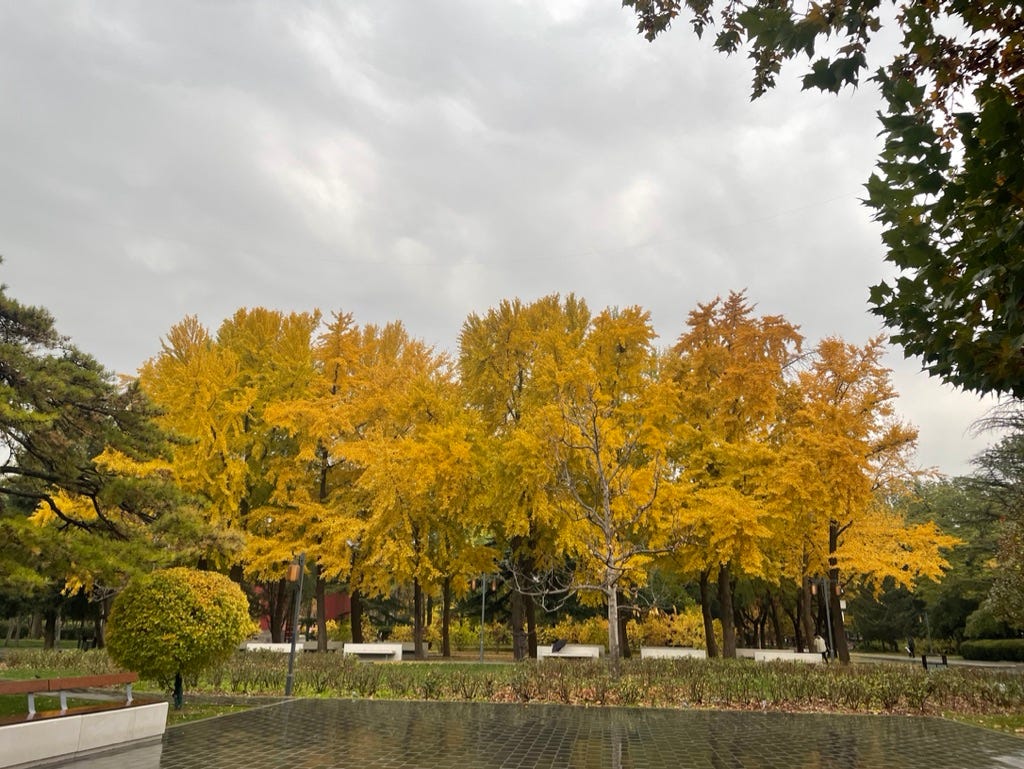
A belated apologies for being absent from your inboxes for so long. I have been away in China, and in due course I will send a Stack on my reflections from my conversations on the trip. In the meantime, please enjoy this gorgeous row of autumnal gingko trees that I spotted in Beijing’s Ritan 日坛 park.
I am also very sorry to hear about the ad hominen attacks. Why do some people/politicians assume opinions are uniform across a particular group? They should learn from my country where a Liberal Coalition (Conservative) politician severely damaged their and their party's reputation in Sydney in the last election with a casual remark which appeared to question the loyalty of Chinese heritage Australians to Australia. She had clearly had not heard of, or noticed, what happened to the Australian journalist Cheng Lei. Love your work.
Some people have nothing better to do than make ad hominem attacks. You have insights into the issue that most people don't. This sounds like a damned if you do/damned if you don't type situation regarding the permitting of the new embassy location. The government obviously had to stall as long as possible before making a final decision.