

Britain is becoming ever more monolingual, starting from its schools. More 18 year olds take A-Levels in PE (Physical Education) than French, German and ancient languages combined, according to a recent report from the Higher Education Policy Institute. (For non-British readers, A-Levels are the pre-university national examination. Students usually take three or four subjects).
My latest column for The Times is on why this should worry us.
Beyond improved employability and training for certain linguistic skills, in my opinion the most important reason for people to try to learn at least one other language is to experience other cultures in a visceral, intimate way.
Language encodes values, history, collective memory, a way to see the world. Different languages pick up different values that are important to their groups. There is nothing like living a culture through speaking its lingo. I write that the most intrinsic value to learning foreign languages:
is to understand and empathise with people across the world in an as unadulterated a way as possible. You don’t need to read Dostoevsky in the original language or watch Puccini without surtitles. You don’t have to be fluent, and many people simply don’t have the time (indeed, learning English as a second language didn’t seem to help much with my own German or French studies at school).
But if it’s possible to have conversations with ordinary people, particularly those not educated or wealthy enough to speak fluent English, well, those can be some of the most eye-opening interactions Anglophone speakers will ever have. We are too cloistered by the privilege of speaking the lingua franca.
I feel this particularly strongly having worked in the China field for some years now. Too many people who make their livelihood on China are unable to speak to ordinary Chinese people on their terms. And there are some who don’t even think that language skills matter for their work, which is even more concerning.
More generally, for the UK, where anti-foreign sentiment is rising, I worry that monoglottism in schools now sows seeds for the future. We should not be afraid of a culture, a language, or a way of life just because they are foreign to us. And yet, a 2020 YouGov poll that found that over a quarter of Brits are ‘very’ or ‘fairly’ bothered by hearing a conversation in a foreign language; rising to 41 per cent for Leave voters.
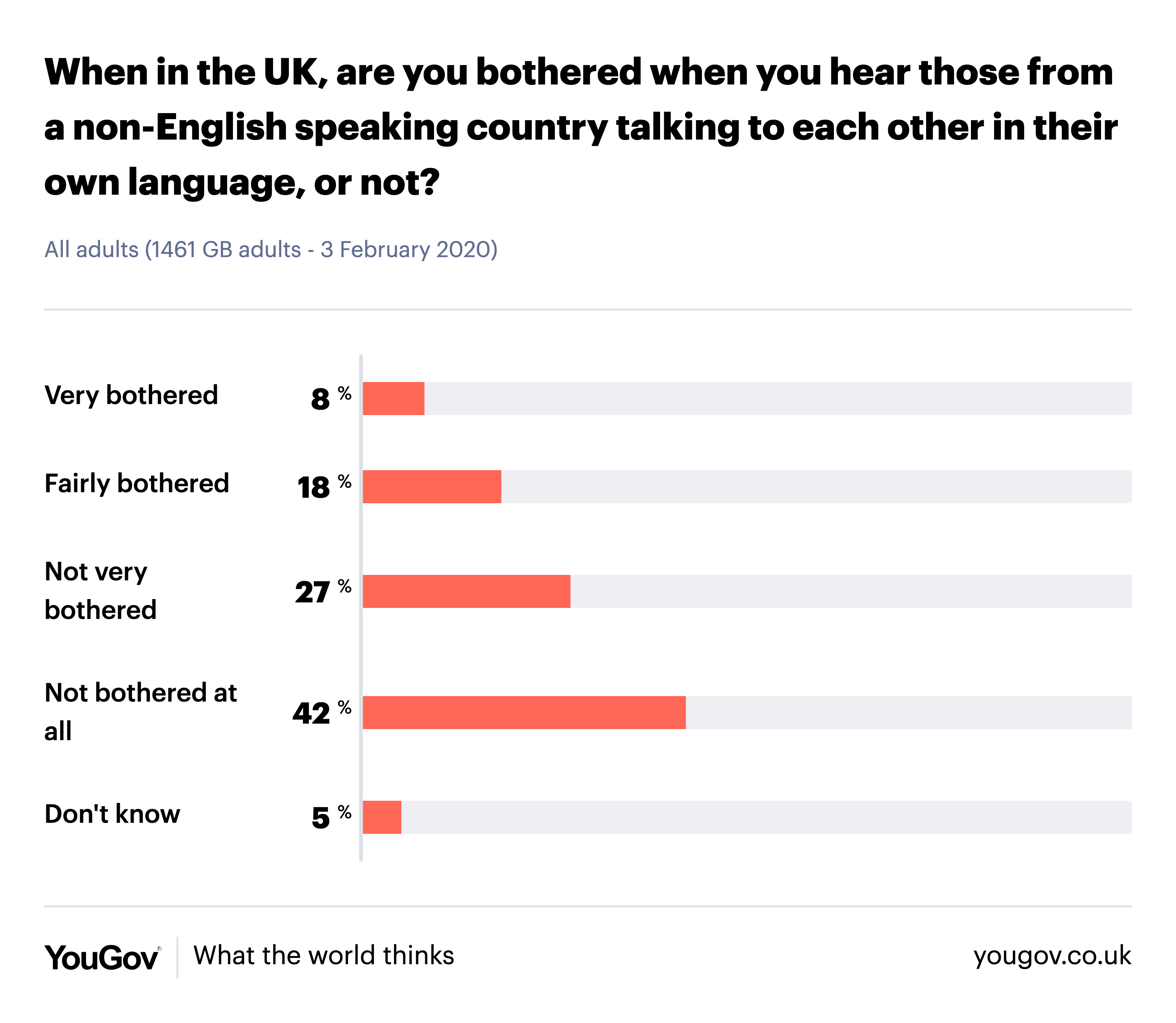
These are much higher numbers than I would have guessed. How did we get to a stage where so many are threatened by even hearing another language? How exceptional that must be compared with the rest of the world, which regularly has to contend with English through films, advertising, music, T-shirts, tourists.
The other article I’ve been working on is the case of Jimmy Lai. His trial has resumed today, having been delayed from last week because of a storm warning and his own health. The 77-year-old tycoon turned activist is facing life in prison in this latest trial, on charges of sedition and ‘collusion with foreign forces’. He has already spent some 1,700 days in solitary confinement in a Hong Kong prison.
I profile Lai for the Sunday Times:
Lai is no saint but he can be considered a hero. The pro-democracy campaigner made his fortune with a cut-throat business acumen, selling tabloids that were crass, salacious and sometimes exploitative. When he fell in love, as he twice has, he pursued the women impatiently and relentlessly to marry him. He was always looking for the next business opportunity and they did not always succeed.
But for decades, he has been a vocal, wealthy and determined supporter of democracy in Hong Kong, a persistent pain in the backside of the CCP. In the months after the crackdown on the 2019 protests, he stayed in Hong Kong to face arrest instead of fleeing. A friend who left remembers trying to persuade the old man to go at one of their last dinners together. But ultimately, “he decided to stay and act as a lightning rod for what was to come”, says his son.

I also look at what the experiences of other prisoners of China can teach us.
Unfortunately for Lai, he is a much more challenging case than, say, the two Canadian Michaels (Kovrig and Spavor) or the Australian-Chinese journalist Cheng Lei. All of these people were essentially taken hostage when their home country’s bilateral relationship with China deteriorated. Lai, on the other hand, has been a decades-long dissident, has thick financial padding (even now) and high-profile connections. Beijing wouldn’t easily let him go.
But the case of the Two Michaels also shows that China reacts to leverage. What leverage does the UK have to get its citizen freed?
Sam Goodman, senior policy director at the China Strategic Risks Institute, suggests it could pay a ransom of sorts. “There is a strong argument for the UK to make co-operation on the repatriation of billions of pounds of stolen Chinese assets seized in the UK, and Chinese nationals involved in money laundering and fraud, dependent on the release of Lai and other political activists in Hong Kong,” Goodman says. Last year, the Metropolitan Police seized £3 billion worth of cryptocurrency from Chinese scammers caught in London.
Another “obvious” idea relates to China’s stalled super-embassy, says Mark Clifford, Lai’s biographer and a former colleague, who leads the Committee for Freedom in Hong Kong Foundation. “When the Cuban missile crisis was defused, for years the US denied that its decision to pull back missiles from Turkey had anything to do with it,” Clifford says. “Of course, it came out later it was completely part of the deal. So why not quietly let the embassy go ahead? It’s certainly something we talk about internally.”
These are controversial quid pro quos. But given the current stalemate and Lai’s deteriorating health, is it not time for some creative thinking, some realpolitik?
Other updates:
The last in a diverse triumvirate of articles is my contribution to the Times Students Guide, an annual publication from the paper aimed at students going into university, ranking institutions and jobs, etc. I was asked to write about my biggest regret. Click here to read and see a much younger Cindy, bartending at a university ball.
I’ve also started a new Instagram account where I will be posting latest articles, life updates, etc etc. If you use that platform, you can follow me on @cindyyu.writes
What I’ve been reading:
Maskpark Cyber-Abuse Scandal Censored, Women Say “Silence Will Only Make It Worse” – China Digital Times write-up of the discovery of Telegram channels in which over 100,000 Chinese men share and consume secretly taken pictures of women, and the ensuing censorship of the scandal.
第一批回家开“村咖”的中产,重新上班了 (‘The First Batch of Middle Class ‘Village Coffee’ Entrepreneurs Have Gone Back To The Office’ – my translation) – a WeChat blog on those who tried, struggled and failed to open indie coffee shops in trendy villages. There has been a revival of the countryside in recent years, with more Chinese (especially younger people) romanticising rural life rather than associating it with poverty (as older generations did). They bring their trendy lifestyles with them, including the drip coffees and the flat whites. But this is an interesting article (in Chinese) of how tough the business environment really is, behind the romance. H/t Amber Zhang’s Baiguan Substack.
Cindy: speaking of “indie” ventures in rural China, you might enjoy this:
https://chinaheritage.net/journal/the-strange-tales-of-aladdin-dogballs/
In my opinion, being bothered by hearing a conversation in a foreign language is being conflated with xenophobia, or a more general reluctance to engage with foreigners. The suspicion of foreign tongues is, in this country, tied intimately to the mass immigration of the past three decades, which has been forced on us without our consent. It's tied to a sense of being alienated in our own country, and shouldn't be linked to a more general lack of interest in, or suspicion of, foreign cultures and languages.
On the subject of language instruction, it has always been poor in our schools. Boring text books and cassette tapes of conversations that bear no relation to the sort of speech you're likely to use on holiday or in business meetings. The Web has changed much for those of us looking to learn a foreign language in adulthood. No more stilted conversation tapes; now we can search for live news in foreign languages, podcasts and written articles, too. And on topics that are of interest to us. That's key. There is a certain amount of slog in learning a foreign tongue, and it's made much easier when we can tailor the content to our own interests. If schools want more pupils to take an interest in foreign language study, perhaps they should drop the regimented learning of the past and try to guide pupils towards foreign language content in which they actually have an interest.