

I suspect that you will, like me, have been glued to the news on Saturday. At the start of the day, I thought my next column would be about the economic pitfalls and opportunities for China in 2026, making the argument that it is a tale of two economies (a theme I might come back to later). Then the news broke: Venezuelan president Nicolas Maduro had been captured by American special forces and extracted to the US in a lightning operation that took one hour 22 minutes.
The world feels like a more dangerous place after that day. Not because the international rules-based order (a phrase I’ve never liked) has ended. That order likely never truly existed.
No, the world is more dangerous today because everybody now knows that the nice warmth of rules and laws is a mirage. If it ever existed, it was like the fairies of Neverland, whose existence depended on enough people believing in it. America – or at least Donald Trump – has now shed the pretence.
So I pivoted my column, looking instead at the Chinese reaction. I summarise them into three emotions: shock, admiration, and vindication.
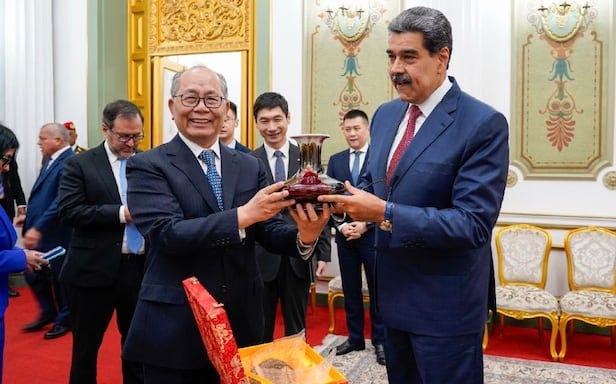
Publicly, the reaction has been as you would expect: shock and condemnation. A Chinese delegation was among the last people to see Maduro as a free man, their meeting full of smiling faces just hours before Delta Force swept in.
Across the government’s official statements, the media reporting and social media discussion, there is ample criticism of American imperialism, 美帝国主义.
But you can bet that behind the scenes, analysts are already poring over how exactly America pulled off the feat. As I write in the column:
For all of China’s military funding and modernisation of recent decades, Donald Trump was not boasting when he said that “no nation in the world could achieve what America has achieved”. More than 150 aircraft took off from 20 locations on sea and land, operating on CIA intelligence of Maduro’s day-to-day movements, secretly gathered since August. Venezuelan airspace defences were disabled electronically and kinetically, as were, apparently, lights in the city.
Beijing will want to answer two questions. First, how well could it counter any similar subversion from the US? And second, how might it be able to exercise a similar level of military and intelligence prowess one day?
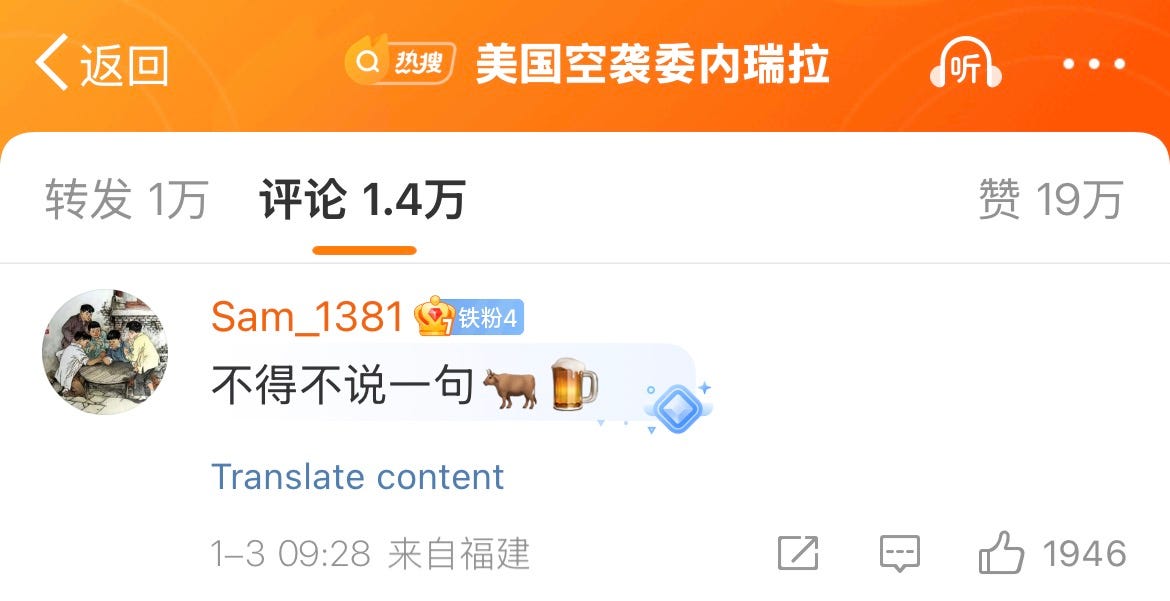
In fact, admiration for the display of hard power (and the understanding that China could learn from it) is also apparent on social media. A titbit I didn’t have space to include in the column: people using the emojis for cow (niu) and then beer (pi) as a way to praise the heist as ‘kick-ass’, niubi, 牛逼.
But above all, Trump’s flagrant disregard for international law will vindicate China:
Of course, expect China to emphasise America’s loss of moral authority, to drum up support for itself in the rest of the world. But at the end of the day, Xi Jinping knows as well as Trump that might makes right in international relations.
That’s why, long after the shock has worn off, the enduring lesson for China will be a sense of vindication. Operation Absolute Resolve is a confirmation of what the CCP has always believed — that there is no such thing as a rules-based international order; that it’s a jungle out there.
In my column I also correct the two types of hot takes on Taiwan that have emerged in the last few days: one, that loss of Venezuelan oil will prevent a Taiwan invasion, and two, that Trump’s action gives permission for China to also disregard international law and encourages a Taiwan invasion. I think both takes are wrong.
Instead, after the investments are stabilised and the oil routes renewed (Trump has signalled that he would be willing to sell to China), the enduring lesson for Beijing from this episode – or rather, reminder – is to keep investing in hard power: technology, the military, trade, espionage. That is the only currency that matters.
Welcome to the new world order.
Very astute observations Cindy. We live in interesting times for sure.
Interesting article Cindy. Seeing the special op described as 牛逼 made me laugh.
It strikes me that the attack on Venezuela also vindicated what the Far-Left has always believed: that the US is an imperialist power intent on stealing other countries' natural resources.
Do you think that this is a commonly held view in China?
You mention that many Chinese admire Trump. I think this is true. One of my Chinese friends told me that she thinks Trump is doing a good job by removing a socialist dictator, though I'm sure this is a minority view.
But as well as Chinese democrats celebrating the Venezuela raid, isn't it strange that a Communist country like China also contains a strong "right-wing" that expresses an almost Nietzschean admiration of American hard power and strength? Similarly, there is a mocking attitude towards countries like Russia, which is described as a 'weak goose' 弱鹅 by Chinese ultra-nationalists on social media for its poor performance in Ukraine.
The variety of political views within China is quite fascinating, especially when it comes to foreign policy. Where do you think most Chinese people stand on this? Do they lean more to the Left or more to the Right?